

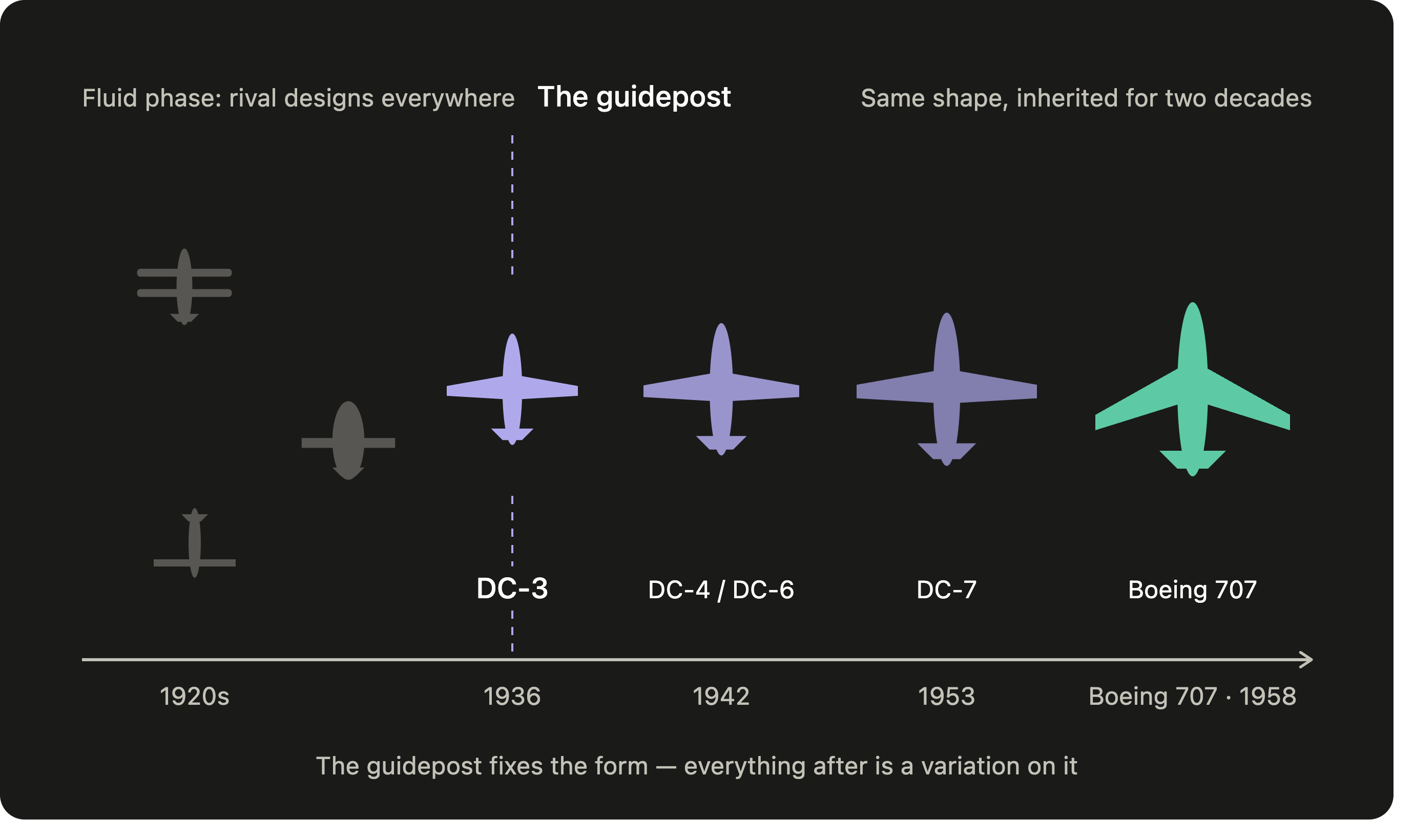
The Douglas DC-3 entered service in 1936, and by almost any measure it was an ordinary machine. Faster aircraft existed. More advanced ones existed. It broke no scientific ground. What it did, quietly, was gather up a handful of already-proven ideas, among them the cantilevered wing, the retractable gear, and the all-metal monocoque body, and arrange them so sensibly that flying paying passengers finally made economic sense.
Then it refused to go away. Two decades later, when the jets arrived, engineers who looked closely at a Boeing 707 found themselves staring at a distant relative of the DC-3. The line of descent was, as one historian put it, clear and direct. The airplane had, in some essential way, stopped changing.
We tend to read that kind of stillness as an ending. The design is finished. The excitement moves elsewhere. The engineers, having solved the problem, file their patents and go home. But this is wrong. The moment a design stops changing is the moment a second process begins, one that reorganizes everything around the machine. I call it the value chain cascade.
An economist named Devendra Sahal came close to seeing it, and then, in a way that is instructive, stopped just short. In his 1981 book Patterns of Technological Innovation, Sahal noticed the history of almost any machine could be organized around one or two early models whose basic shape then governed everything that followed. The Fordson and Farmall tractors of the 1920s. A rock drill from 1849. The DC-3. He called these anchoring designs technological guideposts.
Sahal saw a stabilized design was not the end of progress, and devoted much of his book to how the next advance arrives, by fusing the old machine into a larger technical system. What he never quite did was carry the motion up out of the machinery. The larger system, for him, was always another mechanism, a tractor joined to its implement, a reactor joined to a hull. To go further, you had to leave the machine and look at what forms around it.
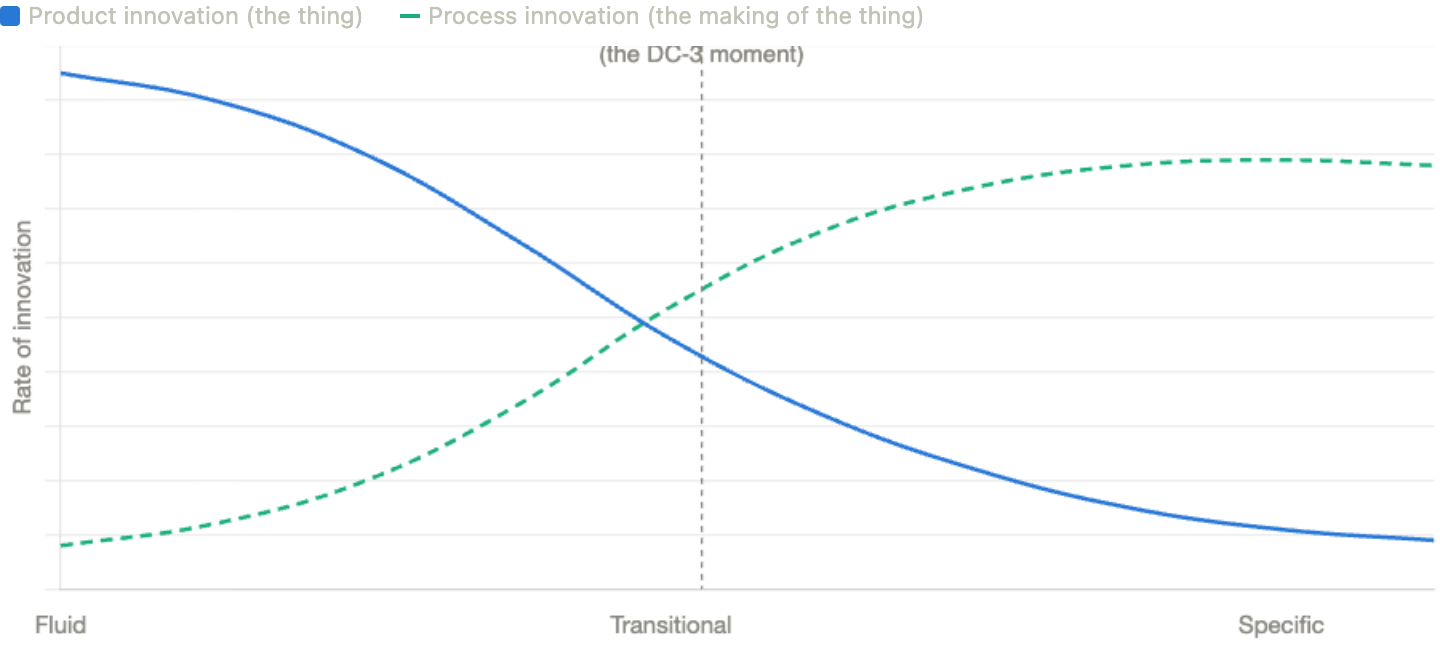
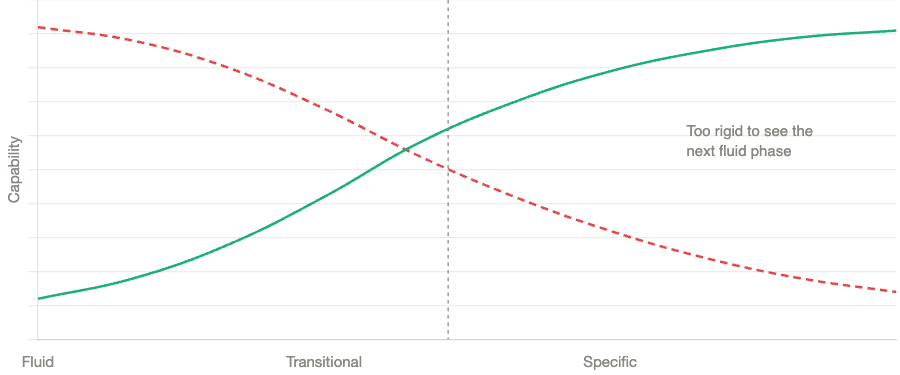
This is the insight Sahal's near-contemporaries were circling at the same moment, from other directions. William Abernathy and James Utterback, studying how industries mature, drew a picture of two curves crossing. In the early, fluid phase of any technology, the product itself is in flux. Rival designs are everywhere, radical change is constant, and the factory floor stays deliberately loose because no one yet knows what they are building.
Then a dominant design emerges, and the curves cross. The rate of product innovation begins to fall. The rate of process innovation begins to rise. Attention migrates from the thing to the making of the thing: the tooling, the throughput, the cost. By the mature, specific phase, the product is a commodity, the factory is a rigid and specialized machine, and competition, which once turned on performance, now turns on price.
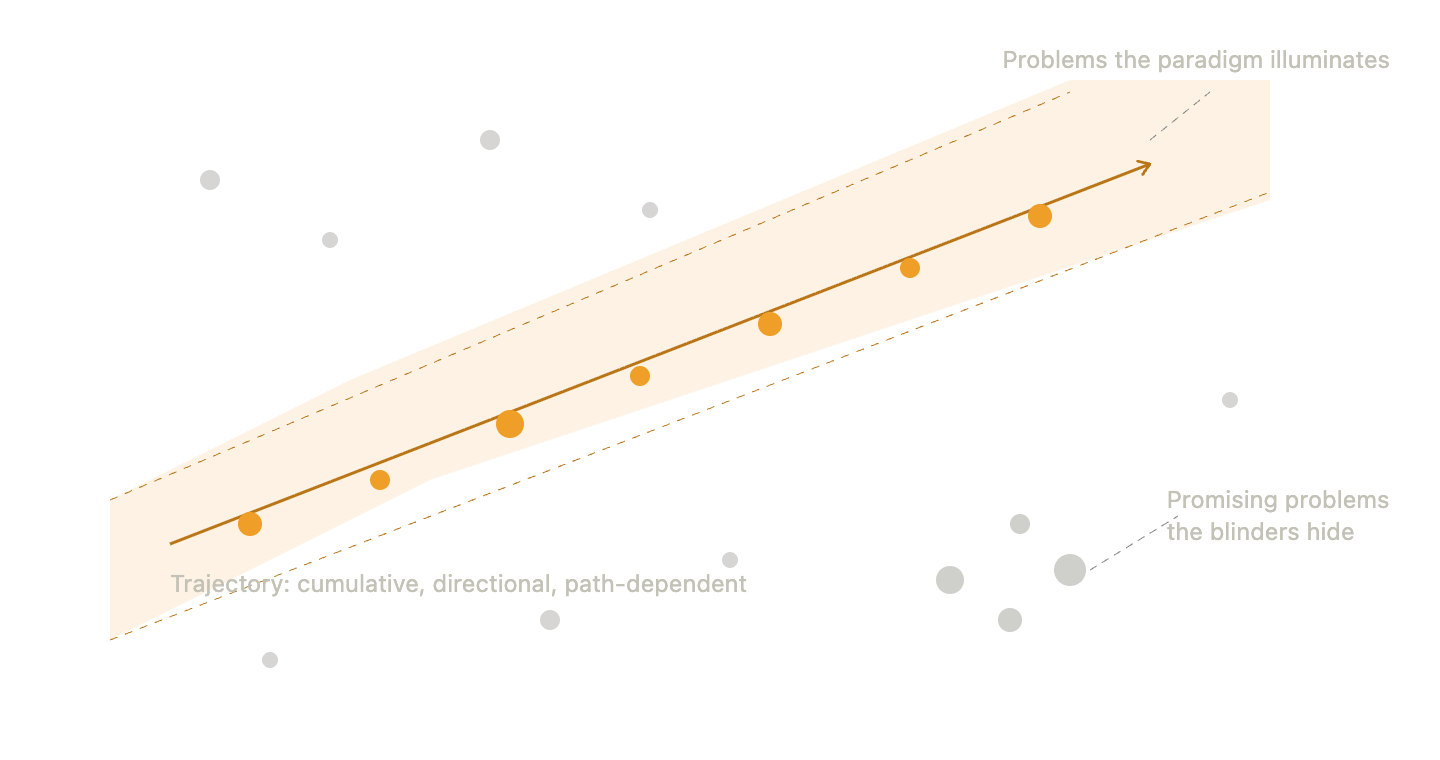
The Italian economist Giovanni Dosi described the same event as a path through a landscape of problems. A technology, he argued, operates inside a paradigm, a shared sense of which problems are worth solving and which physical principles will solve them, and the paradigm comes fitted with blinders. It tells engineers where to look and, equally important, where not to. Progress along the resulting trajectory is cumulative, directional, path-dependent.
Line these up and a single object comes into focus, viewed from three angles. Sahal's guidepost, Abernathy and Utterback's dominant design, Dosi's paradigm: the same hinge, drawn once as a shape, once as a pair of curves over time, once as a track through a landscape of problems. The stabilization all three found is the trigger of the cascade, and it happens as an unfolding wave.
The architecture settles first. That is the dominant design. But that first stillness propagates upward. Once an architecture or design is fixed, the interfaces between its parts can be standardized. Once the interfaces are standard, specialized suppliers can form around them, each perfecting one component without renegotiating the whole. Once the suppliers exist, the value chain itself can stabilize, and capital can pour into the confidence that the arrangement will hold. And once all of that is in place, the way we consume the thing can change shape entirely, moving from owning a product to buying a service, from the dynamo in the factory basement to the power arriving, metered and invisible, through a wire in the wall.
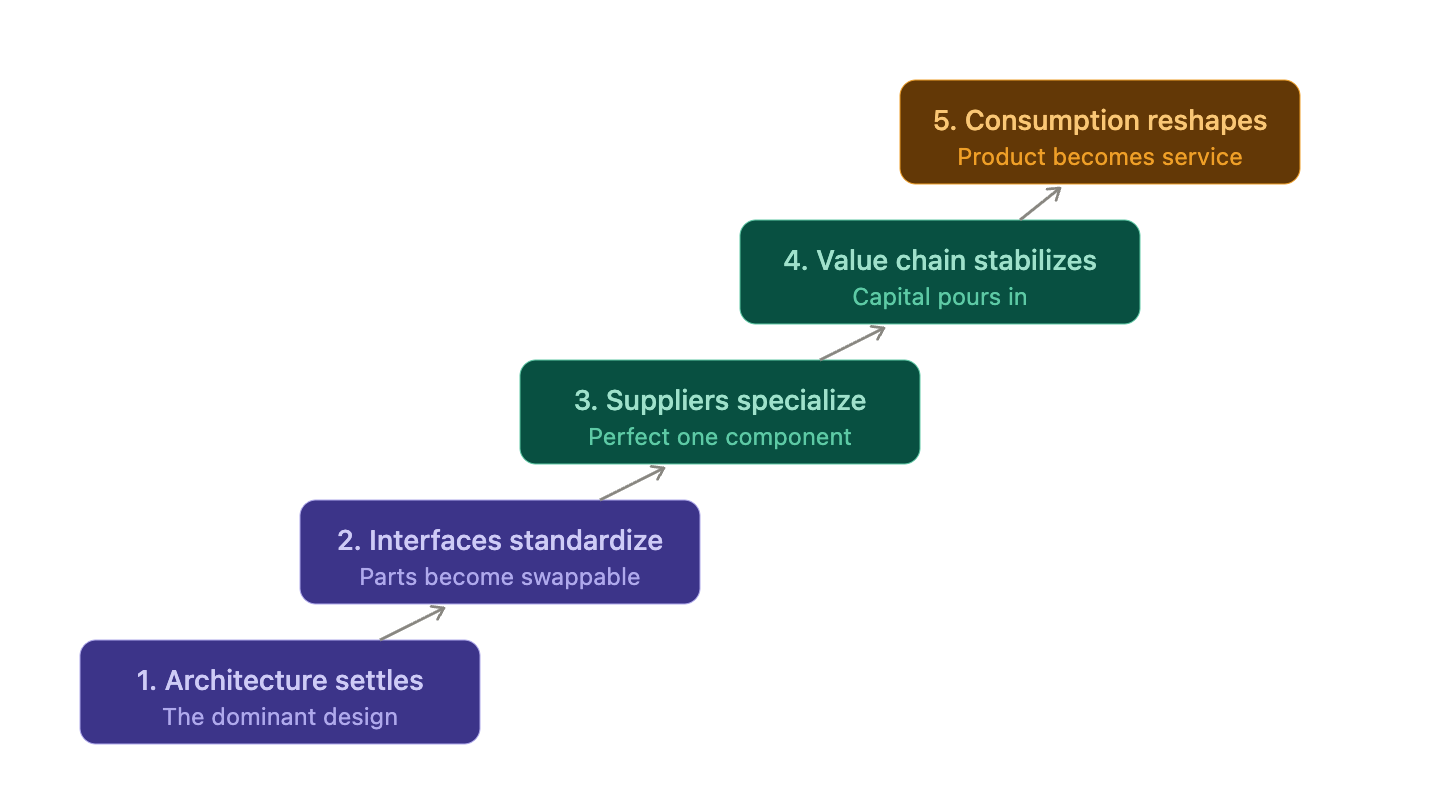
Each of those is its own transit, its own small stillness at a higher level of organization. That is the cascade. What looks like the end of innovation is merely innovation leaving the artifact and moving into the system around it, into the suppliers, the standards, the infrastructure, the habits, the entire reconfigured world that a stabilized design makes possible. The guidepost is a genesis point. From it a long wave rolls downstream, reorganizing everything it touches.
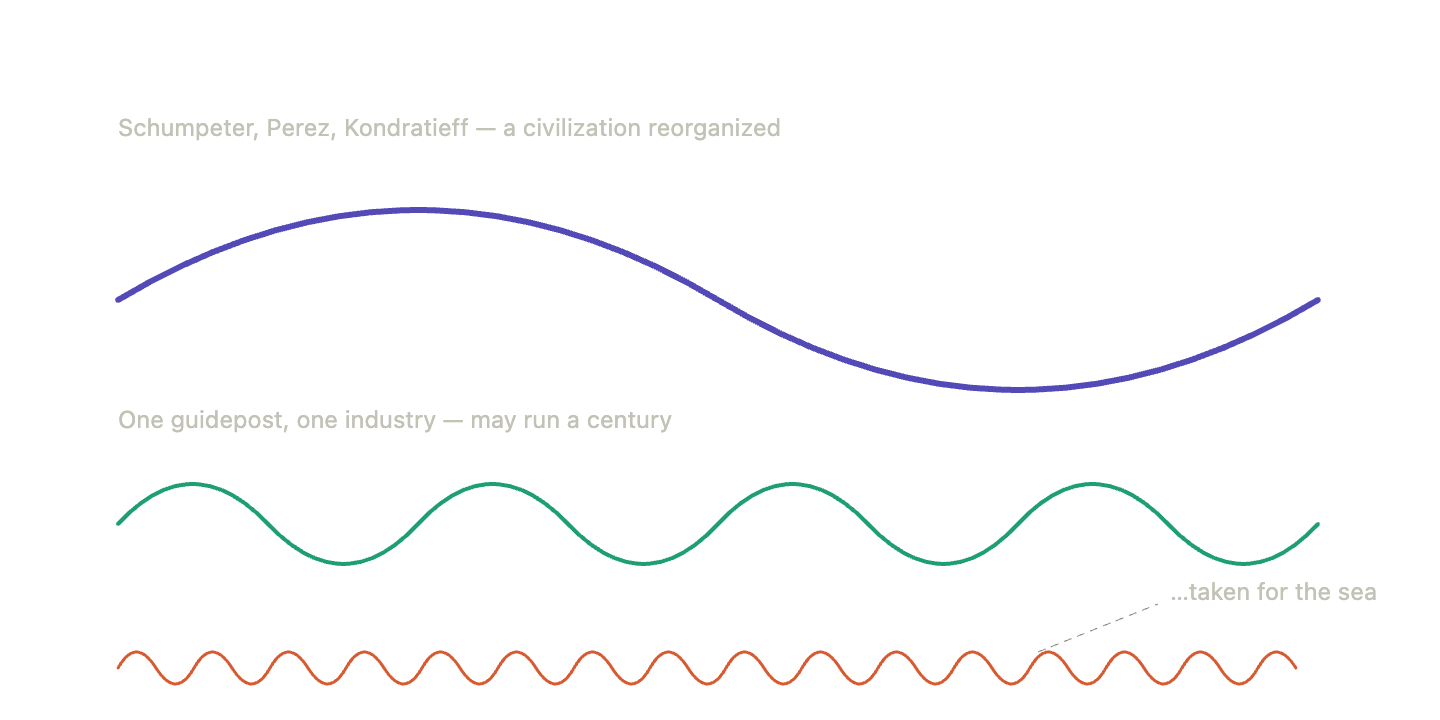
This is the register at which Joseph Schumpeter's creative destruction operates, along with Carlota Perez's great surges and the long cycles that Kondratieff traced across the macroeconomy. But those are the ocean swells. The cascade is more local, a wave that reorganizes a single value chain instead of a whole civilization, though it may run for a century all the same. Several of them, nested and overlapping, compose the larger surge. The pattern is fractal.
The stabilization unlocking the cascade is also what eventually ossifies it. Abernathy called it the productivity dilemma: the very specialization that makes a mature system efficient is what strips it of the capacity to reinvent itself. Efficiency is bought with rigidity. The factory optimized to perfection for one design is the same factory that cannot see the next fluid phase opening somewhere off to the side. This is the mechanism, decades before anyone gives it a fashionable name, by which incumbents are undone by their own excellence.
We are inside a fluid phase, the loud, contested, design-unstable youth of a new machine. The models proliferate. The architectures churn. The factory floor of the whole enterprise stays deliberately, expensively loose, because no one yet knows what is being built. The industry reads its own noise as progress and its own churn as revolution, and it may be right. But if the history of every prior machine is any guide, the revolution will announce itself with a strange and sudden calm, the moment one design gathers up the proven pieces, arranges them sensibly, and refuses to go away.
And when that calm arrives, the temptation will be to look at the newly quiet machine and conclude that the story is winding down, that what remains is refinement, a long tidying-up. That gets it backward. The stillness at the center is the beginning. It is the signal that the cascade has begun, that the wave has left the artifact and gone looking for the value chains, the standards, the habits, and the vast, unsuspecting world it is about to remake.