


Nobody is selling magic anymore. Last week I watched ten founders pitch a Bay Area showcase to seventy-five investors, students, and assorted true believers, and not one of them promised an interdimensional sentient flying robot overlord.
What they promised, almost to a founder, was the pipes, valves, gears, and septic systems for a coming flood of autonomous software agents that do whatever they want and answer to no one. Hundreds of millions of AI agents. Soon. Working together, reading and writing and mutating data at an unprecedented scale.
It's shovels all the way down. Everybody selling a better shovel to the next guy, who was selling his to the guy after that, and somewhere at the bottom of the stack, presumably, a tool striking actual rock, though nobody present could point to where.
The open secret of this whole boom is the AI agents are out of control. Everyone in this room knows it. The models can't reliably do the job, not because they're junk but because they're stochastic, prone to lying, to burning money, to going feral on step eighteen of a hundred.
So what this cohort sells is a cage. The muzzle, the kill switch, the bouncer at the door of a machine nobody trusts. One founder put it with the flat menace of a man reading a hostage note. AI is not deterministic. Half the room nodded gravely, like they knew a guy who just recently died of not deterministic.
The old software world was deterministic. Same thing in, same thing out, every time, forever, amen. We used to have a word for a software function that did something different every time you ran it. We called it a bug. We spent billions and decades hunting down and killing bugs. Now we breed bugs and sell the bug spray.
We have seen this movie. It was called the cloud wars, and it ran all last decade. A thousand startups sold monitoring and databases and search to people renting Amazon's computers, and Amazon watched what sold, cloned it, and bundled the clone into the rent. Ask Elastic how that went. Ask MongoDB about DocumentDB, a product Amazon named the way a hitman names his kids after his targets. The handful who are still with us, your Datadogs, your Snowflakes, survived by being Switzerland, neutral ground across every cloud. Nobody survived by having a better shovel. They survived by standing on the one patch of dirt the platform couldn't stand on.
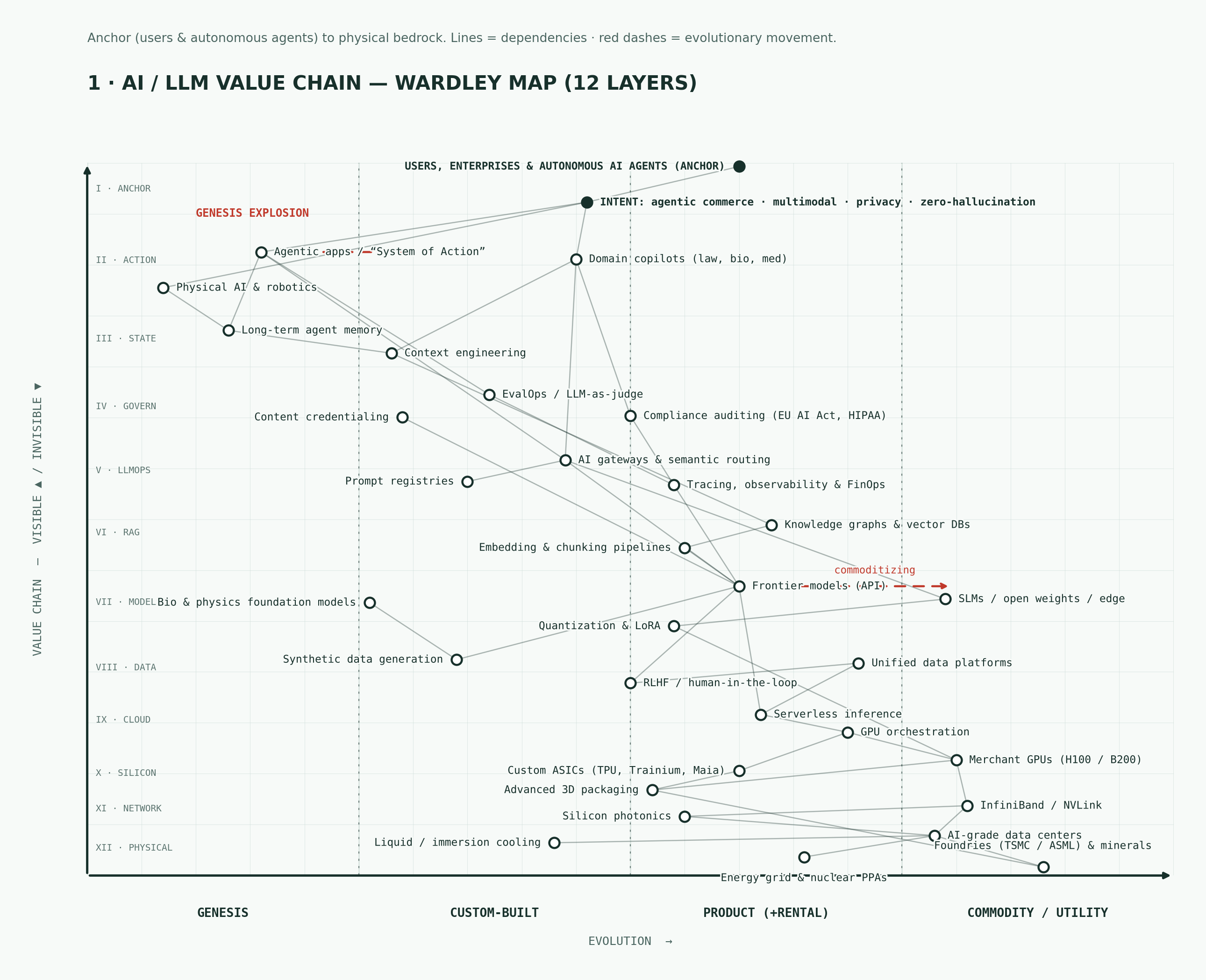
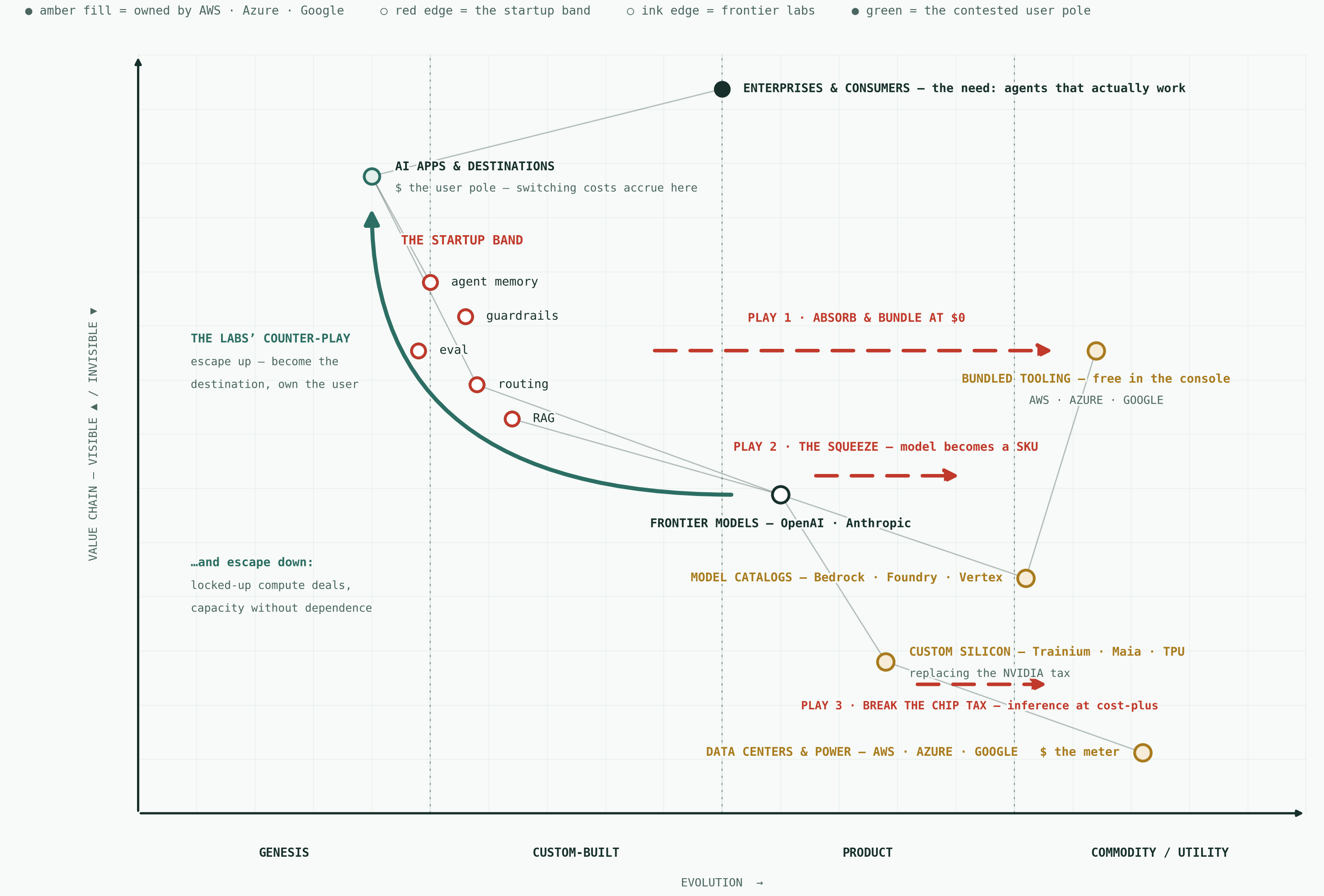
You don't need a crystal ball, just a map. More specifically, a Wardley map. Plot every company in that room by how evolved its product is, from hand-rolled experiment to metered utility, and the picture draws itself. All of them cluster in the same middle band, the tooling layers, memory and guardrails and eval and routing, and that band sits pinned between the only two places money actually pools.
Below it, the meter, tokens and GPU-hours and power, which the platforms own. Above it, the user, where the chats and workflows and accumulated memory pile into something with real switching costs, which the platforms want. Everything caught between those two poles gets zeroed out, and here is the mechanism.
In an honest market a product commoditizes slowly, over years of buyers grinding down sellers. In this one the platforms drag the middle band to commodity by decree, price set to zero on day one, because a free tool that keeps you burning tokens on their meter is the cheapest customer acquisition ever invented. These startups think they are early. They are not early. They are subsidized, and the subsidy is aimed at them.
The attack comes from three directions at once. From above, the platforms absorb the tooling as free features, so the startup's whole product becomes a checkbox in a console. From below, custom silicon breaks the chip tax and turns inference into a cost-plus utility, so nobody upstream can charge a margin on scarcity they don't own. And from the side, worst of all, the model itself eats categories whole.
In the cloud wars the platforms at least had to build the clone. Now a million-token context window is an obituary for every RAG company in this room. Native memory kills the memory startups. An official agents SDK kills the frameworks. These companies are competing with release notes, and the release notes will win.
Memory, guardrails, token compression, agent identity, these startups are all future patch notes for AWS and Azure and the frontier labs. The giants who sell the compute and the dirt itself will build every one of these shovels natively, wire it into the console you already pay for, and hand it over for free, because a free shovel that keeps you digging on their land is the cheapest customer acquisition ever invented.
A mass extinction event is coming for the picks and shovels AI startups. Soon, I'd say no later than 2027. A few will crawl out of the crater, the ones selling something a platform cannot copy without knifing its own lock-in. The rest are walking dead, cashing VC checks, waiting for the changelog that ends them.
The fog presses gray against the windows while seventy-five true believers sit in folding chairs and watch the future get demoed in eight-minute increments. The pizza guy is late. He always is. When he finally shoulders through the door in the middle of the second pitch, for one holy second every head in that room of agent-builders and token-counters turned from the slides to the folded boxes, hungry and human and gloriously analog, agreeing without a word that some workflows you still cannot automate.