


In September 2001, Exodus Communications filed for bankruptcy. Two months later, Cable & Wireless agreed to pay about $560M in cash for 27 data centers that Exodus had built with borrowed money. A little over a year earlier, at its March 2000 peak of $86.66 a share, Exodus had been worth more than $30B. The sale covered a fraction of the $3.5B Exodus owed.
Exodus borrowed against revenue it believed was secure. Its customers were thousands of internet startups. When they ran out of cash together, their contracts stopped paying together.
Twenty-five years later, the industry is borrowing again, on a far larger scale. Nvidia chief executive Jensen Huang puts the cost of a one-gigawatt AI data center at $50B to $60B. CoreWeave, the largest independent builder, carries $35B of debt and $16B of data center leases against a $104B backlog of contracted revenue.
To test whether a gigawatt can pay for itself, we built a Monte Carlo simulation of how a data center earns money. It counts the GPU-hours a facility can sell, multiplies them by what tenants pay, and runs 50,000 times across ranges set by current market data.
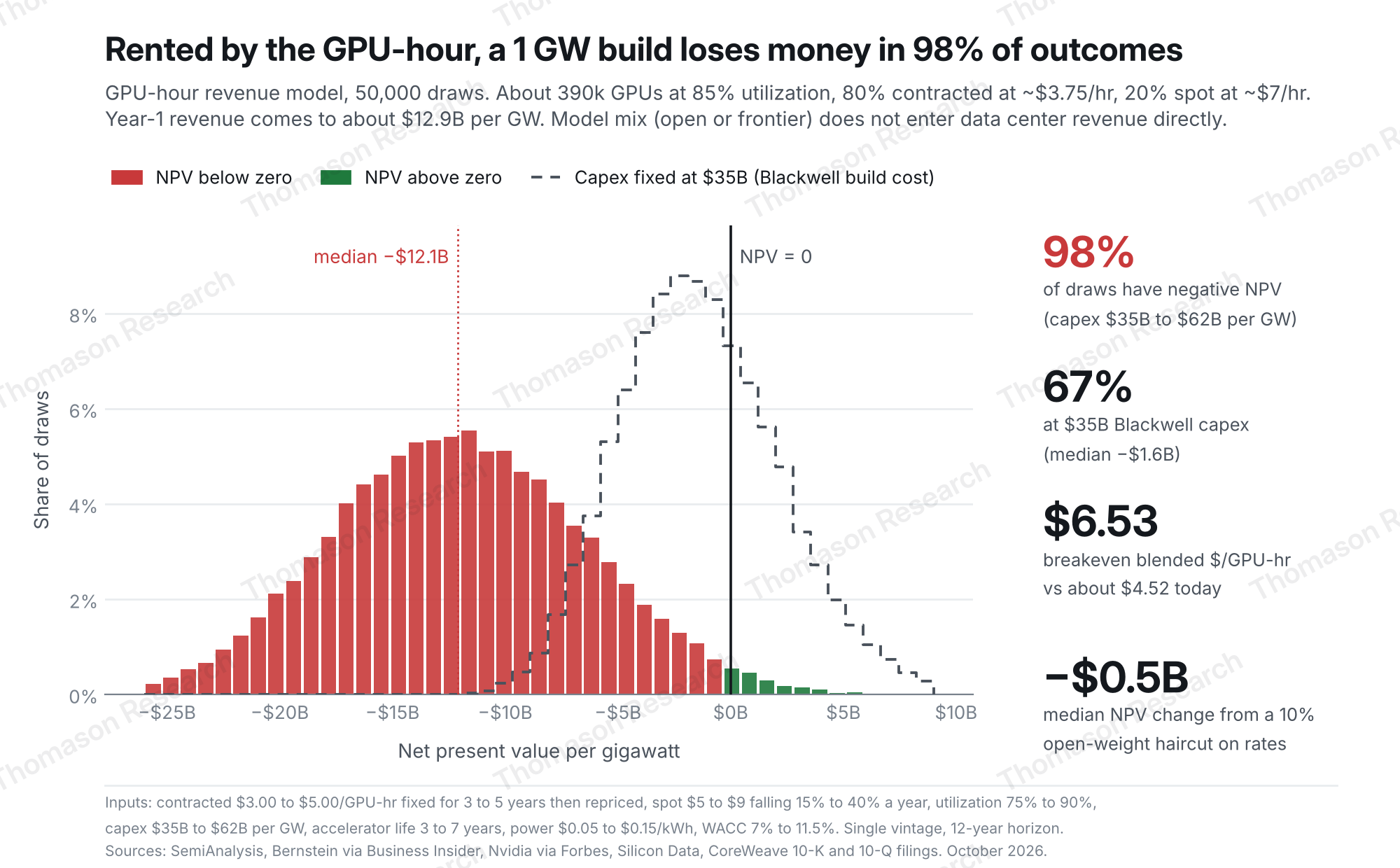
At today's build costs and rental rates, a 1 GW facility loses money in 98% of our simulated outcomes.
The price of a gigawatt
Bernstein analyst Stacy Rasgon puts the price of a gigawatt data center at about $35B, with GPUs about 39% of the total. Jensen Huang's figure is far higher, and (unsurprisingly) about $35B of it goes to Nvidia.
On revenue, OpenAI's own figures imply about $10B of annualized revenue per gigawatt in each year from 2023 to 2025, as its revenue and computing capacity grew together. SemiAnalysis puts the cost of renting a GB300 cluster at about $12B per gigawatt a year, at $3 an hour per GPU.
The optimistic numbers come from the model builders. SemiAnalysis estimates OpenAI and Anthropic can earn more than $100B a year from a gigawatt of inference sold through their APIs. That is gross lab revenue, earned before the cost of training models, so it overstates what the building's owner collects.
A $50B building earning $10B a year needs five full years of revenue just to match its cost, before it pays for power, staff or interest. The chips inside it may not last that long. Microsoft depreciates servers over six years and Meta over 5.5, Bloomberg reported, while investor Michael Burry argues the chips' real product cycle is two to three years.
The open-weight thesis
Our question started with a thesis about open models eroding unit economics for neoclouds. Businesses are shifting work from expensive frontier systems to open-weight models they can download and run themselves. If token prices fall faster than volume grows, the revenue each gigawatt earns shrinks.
The shift is real. Open-weight models handled 34% of enterprise AI tokens in a September survey by Enterprise Technology Research, up from 23% a year earlier. Mozilla found open models carry roughly a third of AI usage but 4% of revenue, so each open token earns a fraction of a closed one.
But this thesis has a weak link. A data center owner sells GPU-hours, and the hourly rate is the same whether a tenant runs an open model or a frontier one. Open models can reach the owner only indirectly, through how many hours tenants want and whether tenants can pay.
How a gigawatt earns money
Operators describe their business in two numbers: the hours they can sell and the rate tenants pay. Most capacity is sold on multiyear contracts, and the rest at spot prices that move with the market.
A gigawatt holds roughly 390,000 GPUs. At 85% utilization, with 80% of capacity contracted near $3.75 an hour and 20% sold at spot near $7, year-one revenue comes to about $12.9B.
The contracted rate sits a little above the $3 an hour SemiAnalysis uses for a GB300 cluster. That puts revenue close to the $10B to $12B anchors above.
Across build costs of $35B to $62B, 98% of simulations lost money, with a median loss of $12.1B. Breaking even required a blended rate of about $6.50 an hour, against roughly $4.50 today.
Our biggest assumption is that rates fall. Revenue slips about 7% a year while contracts hold, because only the spot share reprices, then drops as contracts roll over at lower rates. Early H100 rentals often ran $7 to $10 an hour, and Silicon Data's H100 rental index were at $2.89 on Oct. 25, 2026.
So we also ran the model with rates frozen forever.
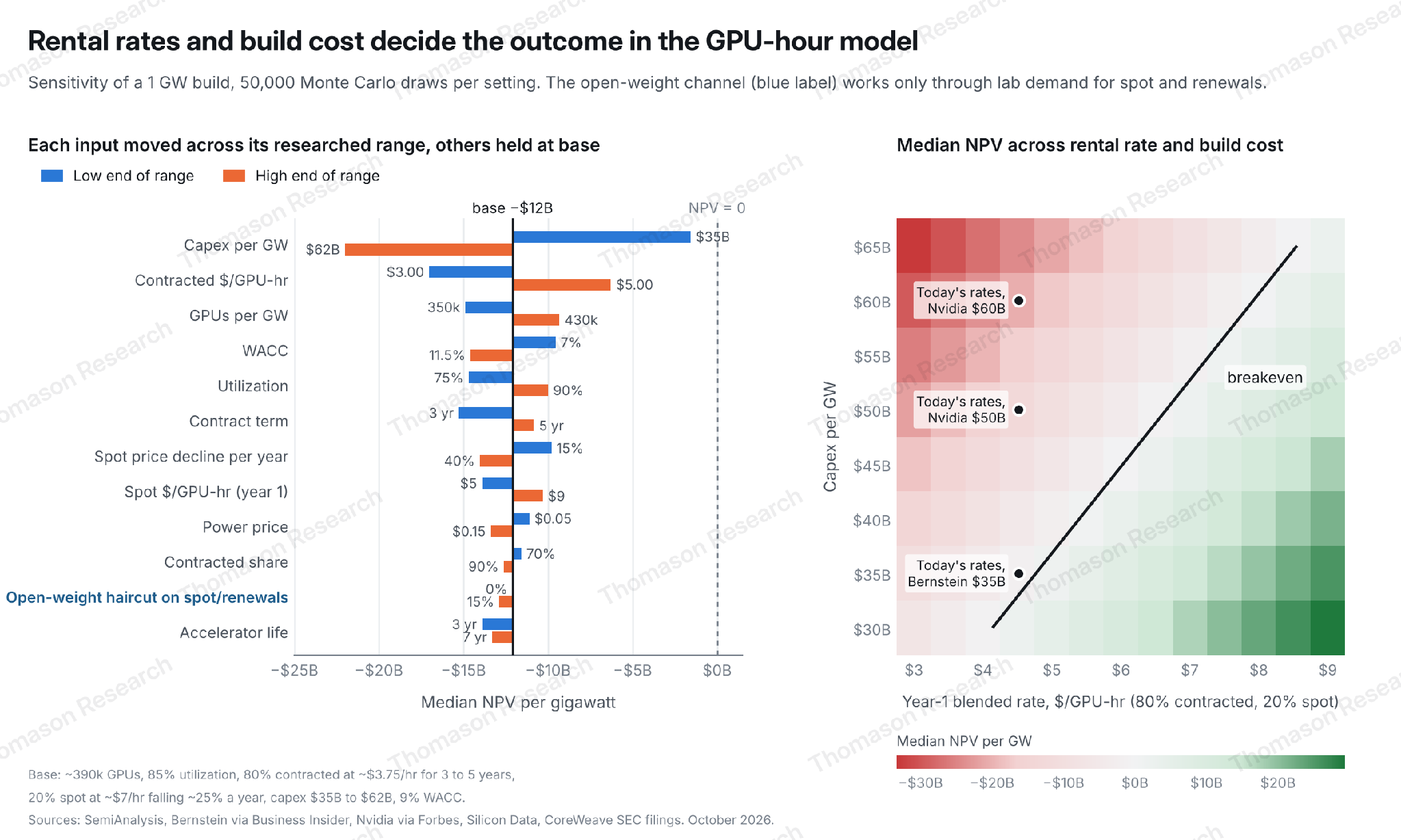
Flat rates change the answer for cheaper builds. If rates hold, a gigawatt built at Blackwell's $35B cost makes money in 86% of runs. At the $50B to $60B that current builds cost, flat rates still lose money nearly every time.
The evidence on rates is somewhat murky. On its August earnings call, CoreWeave said it had signed an A100 contract running into 2029 and raised prices about 25% in July, with near-term capacity sold out. We view this as a temporary result of supply constraints. The H100's slide shows how fast a generation's rates can fall once its successor ships.
Where open models bite
If model choice never touches the hourly rate, open models can only hurt a landlord indirectly. We added three such channels to the GPU-hour model and tested each one.
The first is demand. Smaller open models need less computing per token, so in theory a shift toward them empties data centers. Cheaper tokens also draw more use, though, and the model tracks which force wins.
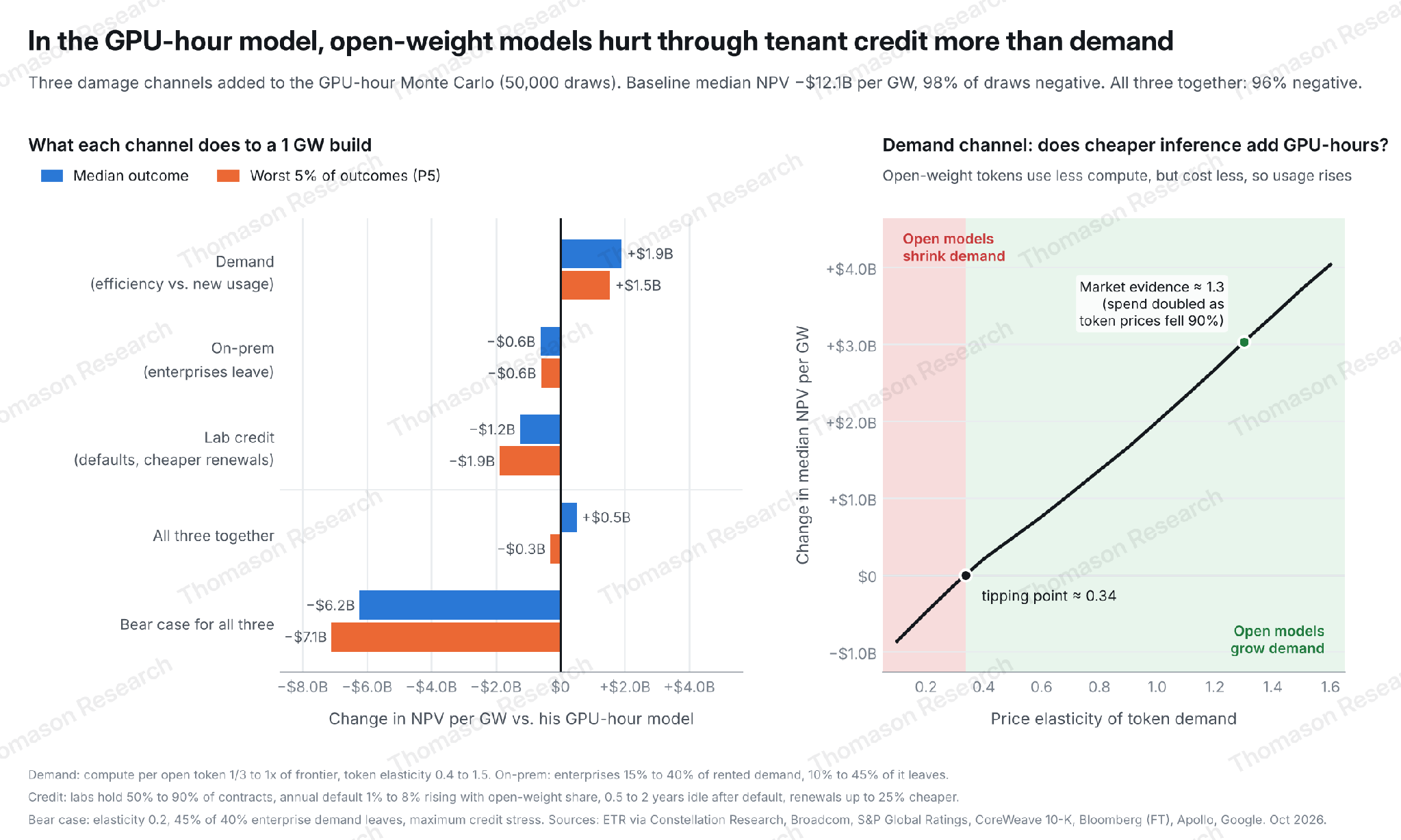
The key number is price elasticity of token demand. Above about 0.34, new usage outruns the efficiency gain and GPU-hours rise. The market suggests far more: token spending has roughly doubled since late 2025 while prices sit more than 90% below 2023 levels, an elasticity near 1.3.
Google's monthly token count tells the same story. It rose from 9.7T to more than 480T in a year, the company said in May 2025. In the model, this channel added $1.9B to the median gigawatt.
The second channel is on-premises computing. Open weights let companies run models on servers they own, and in Broadcom's survey the share of enterprises using public cloud for production inference fell from 56% to 41% in a year. Enterprises are a minority of rented demand, however, and this channel cost the median gigawatt $0.6B.
The third channel is credit. If open models squeeze frontier labs' margins, the data center's largest tenants become weaker payers. OpenAI projects $278B of negative free cash flow from 2026 through 2030, the Financial Times reported in September.
We priced that risk with S&P's long-run default data: about 21% of B-rated issuers and 43% of CCC issuers eventually defaulted from 1981 to 2024. Default odds rose as open models gained share. A lab tenant defaulted in 34% of runs, at a cost of about $3.5B each time, and the median gigawatt lost $1.2B.
Together, the three channels roughly cancelled. Jevons effect outweighed the other two, leaving the median $0.5B better off. Only a bear case with flat usage, heavy repatriation and maximum credit stress did real damage, cutting the median by $6.2B.
That result splits the industry in two. Open models squeeze the companies that sell models and the landlords that depend on them. They help owners of diversified clouds, who rent the extra GPU-hours and sell storage, databases and networking around them.
The ghost of Exodus
Exodus grew at a startling pace. Revenue rose from $52.7M in 1998 to $818.4M in 2000, and it lost $256M in 2000. By mid-2001 it carried $3.5B of debt, mostly high-yield bonds and convertible notes.
The convertibles were meant to turn into stock. When the share price collapsed, they stayed debt, payable in cash. CoreWeave carries its own fixed obligations: $16.3B of operating leases, mostly data centers rented on initial terms of 5 to 15 years.
Exodus customers were the weak link. About 4,500 companies rented space in early 2001, and 38% of first-quarter revenue came from young internet businesses.
The industry built as if the boom would last. U.S. data center floor space grew about fourfold in 2000, from 8M to 33M square feet, according to Tier 1 Research. Operators planned to quadruple it again in 2001.
When the money stopped, it stopped all at once. Exodus filed for bankruptcy on Sept. 26, 2001. Chief executive William Krause said the company had "sacrificed profitability in exchange for growth and market share."
The financing then looked familiar. Global Crossing owned about 20% of Exodus and, under a 10-year network deal, supplied at least half its network capacity outside Asia. Today Nvidia is investing up to $100B in OpenAI, a major buyer of its chips, and has discussed guaranteeing up to $250B of lease financing for an OpenAI data center hub.
Two differences stand out. CoreWeave's largest customer, Microsoft, is a far stronger credit than a crowd of dot-coms. Its demand is also running hot, while Exodus filed as new business dried up.
The third difference is Exodus's collateral was buildings, and Cable & Wireless bought them as working data centers. Even so, the sale covered a fraction of Exodus's debt. A lender repossessing GPUs in year three holds hardware one or two generations old.
When customers say "sue us"
A $104B backlog sounds like a wall of protection. Its strength depends on what happens when a customer would rather pay a lawyer than a landlord.
CoreWeave's committed contracts are take-or-pay, with a weighted average term of about five years. Deferred revenue, largely customer billings in advance, stood at $9.7B in June, roughly 9% of the backlog. Nvidia has also agreed to buy any unsold capacity through April 2032.
The exits are real, too. In March 2025, the Financial Times reported that Microsoft had withdrawn from some CoreWeave agreements over missed delivery deadlines, though CoreWeave told Reuters no contracts had been canceled. Either way, a service dispute gives a tenant that wants out a ready reason.
The lenders feel it first. A $2.6B CoreWeave loan traps cash if a material breach gives a customer the right to terminate, and sweeps it toward repayment if the problem lasts three months. A tenant in bankruptcy can also reject its contract, which the Supreme Court has held counts as a breach, leaving the landlord with an unsecured claim.
We modeled the incentive directly. As market rates fall below a contract's rate, the tenant overpays more each year. At some point it either forces a repricing or stops paying, and the owner recovers 10% to 50% of the damages two years later.
Contracts are worth about $7B per gigawatt against repricing every year. With the walk-away option, owners keep about 79% of that value. At least one tenant forced a repricing in 45% of runs and walked in 20%.
When rates stayed flat, no tenant walked in any run, because none was overpaying. Contracts come under attack only when rates fall, which is the moment they exist to cover. If rates hold, revenue holds without much help from contracts. If rates fall, contracts hold revenue up only for as long as tenants choose to honor them.
The profit test
CoreWeave's defenders point to its margins. In 2025, its gross margin topped 70% and its adjusted EBITDA margin reached 63%.
Both figures leave out the GPUs. CoreWeave books server and networking depreciation outside cost of revenue, and EBITDA excludes depreciation by definition. Once the hardware is charged, operating margin was −0.9% for 2025 and −1.9% in the second quarter of 2026.
Overhead explains part of the slide. Sales, general and administrative costs rose from 7.2% of revenue in 2024 to 15.5% in 2025, about half of an 18-point fall in operating margin. In the latest quarter SG&A dropped to 9.2%, and the margin stayed negative.
The depreciation charge depends on how long the chips are assumed to last. If they last four years rather than six, depreciation on CoreWeave's $26.6B of technology equipment rises by about $2.2B a year.
Cash flow tells a similar story. Operating cash flow of $3.1B in 2025 included a $4.2B rise in deferred revenue, largely customer billings in advance. Without it, operating cash flow was negative $1.1B, and free cash flow was negative $7.3B, according to Bloomberg data.
Let's look at return on capital. In 2025, CoreWeave earned about 0% on roughly $21B of average equipment, or 1.4% with overhead held at 2024 levels. Its interest bill alone now runs at about 7% of its debt a year, and shareholders expect more than lenders.
Each dollar of equipment brought in about 24 cents of revenue in 2025. At that rate, and assuming a 9% cost of capital, CoreWeave needs operating margins of roughly 45% to 50% after depreciation just to cover its capital.
We simulated its margins around 2028, 200,000 times, across ranges for rental rates, costs, chip life and the cost of capital. The margin it would need had a median of 49%. The margin it would earn had a median of 2%, and no run reached the margin it needed.
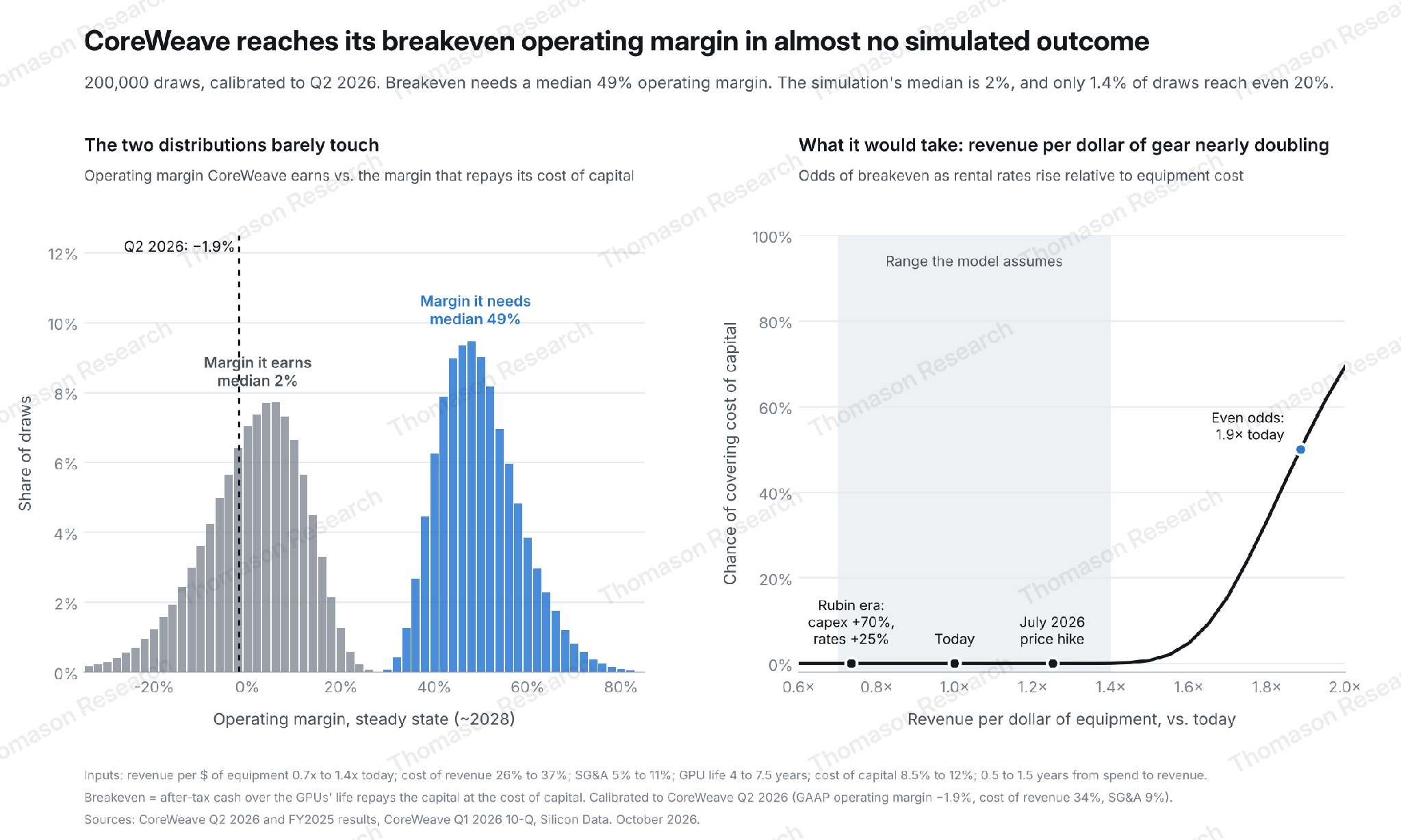
Even odds arrive only if revenue per dollar of equipment nearly doubles. This summer's 25% price increase lifts the median margin to 12%, still far short.
The structure resembles an airline. CoreWeave rents out costly equipment that a stronger supplier sells it and newer models make obsolete. Nvidia earned a 75% gross margin last quarter, lenders collect their interest first, and CoreWeave keeps what remains.
A weak business can still be a profitable trade. If money for new builds dries up, rental rates on existing chips could spike, and CoreWeave's fleet would be worth more for a while. That is a bet on prices, financed with debt that pays off only if the bet does.
What would have to go right
No single simulation input, moved across its researched range, brings the median gigawatt to breakeven. Even the cheapest build, at $35B, loses money in two runs out of three if rental rates keep falling.
Two changes together do work. With flat rental rates and a $35B build, the median gigawatt returns $5.1B and loses money in 14% of runs. Across all build costs, flat rates lower the breakeven to about $5.25 an hour, 16% above today.
In practice, the industry needs three things at once. Revenue per gigawatt must rise by about half, through workloads people pay premium prices for. Buildings must cost near Blackwell's $35B to $40B, and each chip generation must hold its rental rate longer than the H100 did.
Nvidia has made the bull case in public. It says each new hardware generation can yield five times or more revenue from the same power. If even part of that reached rental rates, the math in this article would change.
Under all of it sits a fourth condition, and Exodus is the reminder. The tenants have to keep paying through a downturn, when every one of them has a reason to stop.
In 2001, the buildings were what survived. Cable & Wireless bought them out of bankruptcy as working data centers. In this cycle, the chips may wear out before the debt does.
Methodology
The model values a single 1 GW facility over 12 years, using 50,000 random draws from ranges set by October 2026 data. Each draw discounts after-tax cash flow at a cost of capital between 7% and 11.5%. Chips are depreciated over their economic life and the building over 20 years, with the building's remaining book value credited when the chips retire.
Revenue comes from GPU count, utilization, and contracted and spot rental rates. Add-ons model market demand, on-premises leakage, tenant default and walk-aways.
A second simulation projects CoreWeave's operating margin around 2028, calibrated to its second-quarter 2026 results. It compares that margin with the one needed for after-tax cash over the chips' life to repay their cost at the cost of capital.
The model leaves out several things: chip refresh inside the same building, revenue from cloud services sold alongside GPUs, and the owner's own debt structure. Some inputs rest on analyst judgment where no published figure exists, including the enterprise share of rented demand and the time capacity sits idle after a default.
Contract remedies are summarized from filings and press coverage. Most contract terms are redacted, and actual outcomes would depend on them.
Disclosure: The author worked at Exodus Communications during the dotcom bubble.
Sources
News and analysis
- Bloomberg: Meta's accounting move on AI servers to boost profit
- Bloomberg: OpenAI projects burning through $278B by 2030, FT says
- Bloomberg Law: Nvidia in talks to back OpenAI lease of SoftBank US data center
- CNBC: Michael Burry accuses AI hyperscalers of artificially boosting earnings
- Reuters: Microsoft withdrew some CoreWeave agreements, FT reports
- Forbes: Nvidia to invest up to $100B in OpenAI
- Business Insider: Bernstein's $35B gigawatt cost breakdown
- SemiAnalysis: SpaceX 10GW in 2027, why it's real
- Constellation Research: ETR survey on enterprise open-weight adoption
- Apollo, Torsten Slok: Cheaper tokens, bigger bills
- Silicon Data: H100 rental prices over time
- Silicon Data: H100 rental index
- S&P Global Ratings: 2024 annual global corporate default study
- Exodus 10-Q, Q1 2000: shares outstanding and stock split
- CNN Money (2000): Exodus buys GlobalCenter
- San Francisco Chronicle (2001): Troubles crop up for server farms
Company filings and primary documents
- CoreWeave: second quarter 2026 results
- CoreWeave: fourth quarter and fiscal 2025 results
- CoreWeave 10-K, fiscal 2025
- CoreWeave 10-Q, Q1 2026
- CoreWeave 10-Q, Q2 2026
- CoreWeave 10-Q, Q2 2025
- CoreWeave 8-K: Nvidia capacity order
- CoreWeave 8-K: $2.6B credit agreement
- CoreWeave Q2 2026 earnings call transcript
- Nvidia: Q2 fiscal 2027 results
- Nvidia: Scaling token factory revenue
- Nebius: Q2 2026 shareholder letter
- OpenAI: A business that scales with the value of intelligence
- Google: I/O 2025 keynote
- Broadcom: Private Cloud Outlook 2026
- Mozilla: State of Open Source AI
- Exodus 10-K, fiscal 2000
- Exodus 10-Q, Q1 2001
- Exodus 10-Q, Q2 2001
- Exodus 8-K: Chapter 11 filing
- Exodus asset purchase agreement with Cable & Wireless
- U.S. Supreme Court: Mission Product Holdings v. Tempnology (2019)