


In 1970, the hottest financial innovation in technology was the computer leasing company. Firms like Leasco and Levin-Townsend borrowed money, bought IBM System/360 mainframes, and leased them out, underwriting the debt against eight to ten years of useful life. The machines were scarce, the demand curve only went up, and the residual values looked like a sure thing. Then IBM announced the System/370. The new machine repriced the old fleet overnight, the residuals evaporated, and the leasing complex collapsed.
And yet demand for computing never wavered. It compounded for the next fifty years, beyond anything the leasing companies imagined in their most aggressive models. The function won. The financing lost. The gap between the demand for a function and the fate of the capital serving it one of the most reliable patterns in the history of the technology industry. I count roughly 28 episodes of it across six decades. The AI buildout is currently underwriting trillions of dollars against the assumption that the gap doesn't exist.
The bet everyone is making
The intellectual foundation of the AI capex cycle is the Jevons paradox. Make a resource cheaper and more efficient to use increases demand enough such that total consumption rises rather than falls. The hyperscalers invoke it every earnings call, and they're right to. Every collapse in the price of compute, bandwidth, and storage in modern history has unleashed more demand than it destroyed. Cheaper inference means more inference. The logic is correct about demand. It says nothing about the assets.
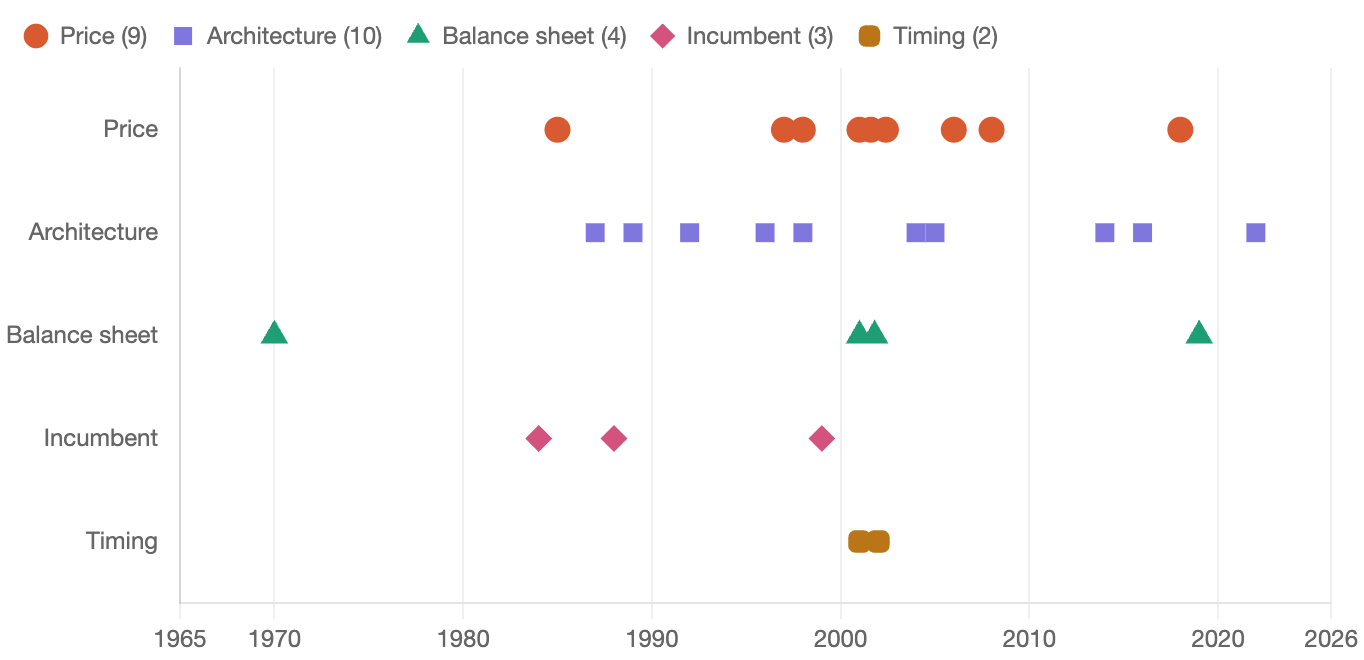
Jevons is a statement about long-run consumption of a function. The capex cycle's solvency depends on short-run revenue to specific, financed machines depreciating on four to six year schedules. Those are different things, and the history of computing is essentially a list of moments when they diverged. Go through the episodes and the function's demand survives in all 28. The capital fails anyway, through one of five channels: the price collapses, the architecture changes, the demand arrives late, the incumbent gets bypassed, or the balance sheet breaks first.
Twenty-eight funerals and a thesis
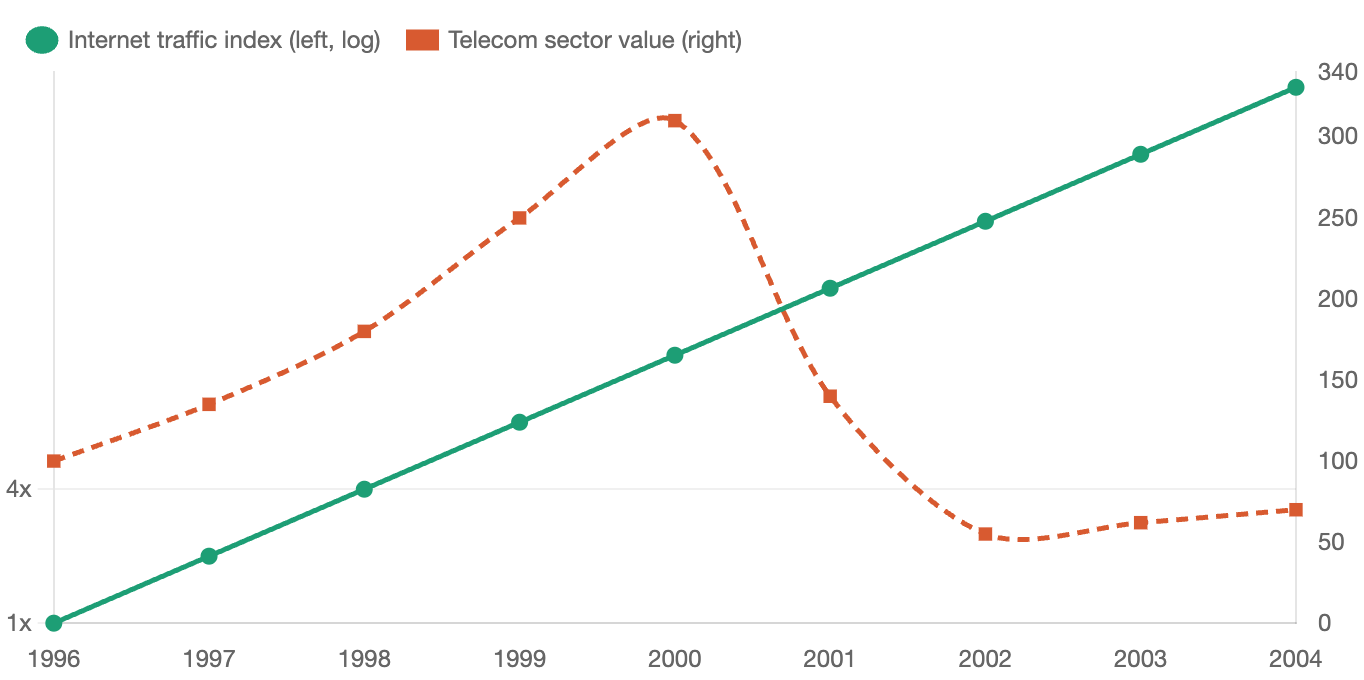
The clearest case was buried in the trench. Between 1996 and 2001, carriers like Global Crossing, WorldCom, and 360networks laid millions of miles of fiber across the United States and under the oceans, financed with well over $100 billion of mostly borrowed money. The thesis was simple. Internet traffic was supposedly doubling every hundred days, so capacity would always be scarce and the strands would always be valuable. Half of that thesis was right. Traffic really did grow 60 to 100 percent a year, straight through everything that followed.
The other half died in a lab. A technique called dense wavelength-division multiplexing, which sends many colors of light down a single strand, multiplied the capacity of fiber that was already in the ground by roughly one hundred times. Supply jumped a generation ahead of demand overnight, and the scarcity that the entire buildout had been financed against simply stopped existing.
By 2002 the builders were bankrupt, and Google was buying their strands for cents on the dollar. The damage then climbed the supply chain. Nortel, which sold the network equipment, rode a quarter-trillion-dollar valuation into bankruptcy while traffic grew the whole way down. JDS Uniphase, which sold the optical components inside that equipment, took what was then the largest goodwill writedown in corporate history. The suppliers to a frenzy, it turns out, are fully exposed to the frenzy.
The fiber crash gets remembered as a one-off mania. It wasn't. The same script had been running for decades, only the names changed.
Memory makers have performed it four separate times. In 1985, in the late 1990s, in 2008, and again in 2018, DRAM manufacturers built factories against extrapolated scarcity pricing, watched prices collapse 60 to 90 percent when the capacity arrived, and wrote off the difference. Demand for memory did not have a single down year across any of those crashes. The 1985 episode pushed the American industry out of the business entirely. The late-1990s episode broke the Japanese firms that had won in 1985.
Architecture shifts ran the script too. DEC, Wang, and Data General, the minicomputer giants of the 1980s, died as computing demand exploded onto commodity PCs they didn't sell. The disk drive industry destroyed its market leaders at every transition from 14-inch platters down to 3.5-inch, while the world's appetite for storage compounded without pause. Clayton Christensen built his entire theory of disruption on that one industry's dataset. And in the most uncomfortable precedent for the present moment, Symbolics and Lisp Machines Inc. sold specialized AI hardware at enormous premiums in the mid-1980s, because serious AI work supposedly required it. Commodity workstations got fast enough within five years, the premium evaporated, and the companies died in the middle of an enterprise AI spending winter whose ROI complaints read almost word for word like today's surveys.
Sometimes the script needs no crash at all, just slow strangulation. In the mid-2000s, VMware's virtualization software let one physical server do the work of ten, and global server shipments flattened for years while computing workloads kept growing. In networking, each new video codec cut the bits needed per stream roughly in half, and internet transit prices fell about 30 percent a year for two decades while traffic exploded. The result was the purest expression of the pattern: staggering value for everyone who used the network, and a backbone industry that never earned its cost of capital. Demand won on volume. Price won on economics.
Then in September 2022 the industry ran what amounted to a controlled experiment. The Ethereum Merge, a scheduled software update, switched the blockchain from proof-of-work to proof-of-stake and eliminated 99.95 percent of the computing power behind an unchanged economic function in a single night. Millions of GPUs were stranded where they sat. Some of that silicon was recycled into the first AI clouds, which is either poetic or ominous depending on your book.
The tape
The roster runs to 28 episodes across six decades, and every one of them sorts into the same five failure modes.
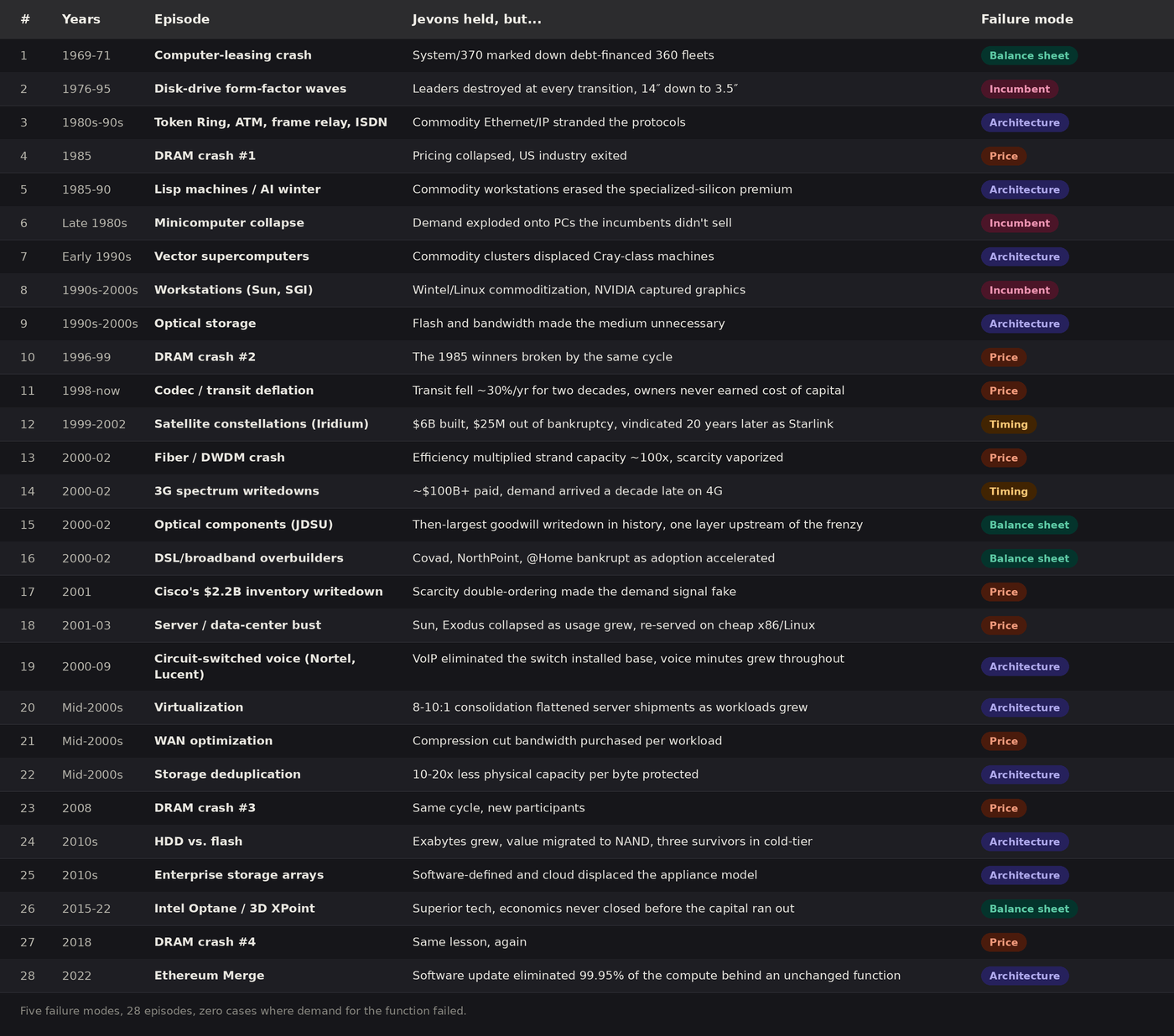
Five failure modes, 28 episodes, zero cases where demand for the function was the thing that failed.
Other people's money
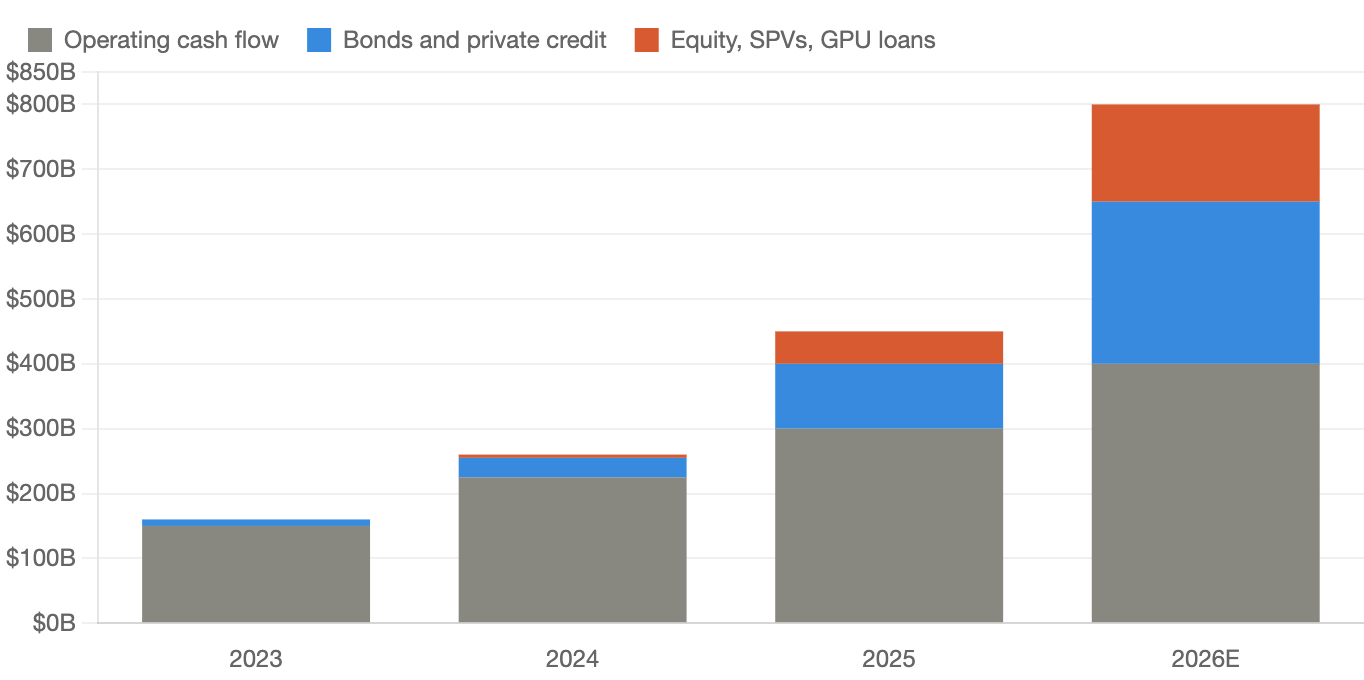
For the first phase of this boom, none of this mattered much, because the hyperscalers paid for the buildout out of operating cash flow. In that structure an efficiency shock is self-correcting, even welcome. Spend less, keep the savings, margins improve, stock goes up. The 1970 failure mode requires outside capital.
The outside capital has arrived. On June 1, Alphabet announced an $80 billion equity raise to fund AI compute, against 2026 capex guidance of $175 to $185 billion and a promise of significantly more in 2027. Investor demand was strong enough that the deal was upsized to $84.75 billion by the next day, the largest equity capital raise in corporate history. The structure tells you who is taking the other side of the trade: $15 billion of mandatory convertible preferred, $15 billion of common stock, a $40 billion at-the-market program to drip shares into the market starting in the third quarter, and a $10 billion private placement to Berkshire Hathaway at roughly $350 a share. This from a company that had already sold $25 billion of bonds in November, more than $30 billion in a global issuance in February, and another $11 billion in sterling and Swiss francs. Alphabet generates more operating cash flow than nearly any enterprise on earth. The capex line outran it anyway.
Four days later, on June 5, the Financial Times reported that Meta executives, led by CFO Susan Li, were weighing an equity raise of their own in the tens of billions, to help fund a 2026 capex budget the company had already lifted to $125 to $145 billion. Meta called the report premature. No banks have been hired. The market rendered its verdict anyway, and the stock fell more than 5 percent on the rumor alone. Note the asymmetry. Alphabet sold $85 billion of actual stock and was rewarded with an upsize. Meta thought about it out loud and lost a multiple of the contemplated proceeds in market cap. The window is open, and everyone watching can see it narrowing. Meta had already gone outside for capital anyway, with a roughly $27 billion private-credit SPV behind its Hyperion data center struck in 2025, sitting alongside rented compute from CoreWeave and Nebius.
Below the mega-caps, the rest of the stack runs on private credit, vendor financing, neocloud debt, and loans collateralized by the GPUs themselves. Goldman Sachs pegs Big Tech AI capex at roughly $800 billion for 2026, and street estimates put 2027 above $1 trillion. Carlota Perez has a name for this stage. The migration of financing from insiders to outside speculative capital is the signature of the frenzy phase of a general-purpose technology, the point where installation outruns the internal cash available to fund it, and where the eventual correctness of the technology thesis stops protecting the capital behind it. When the most profitable companies in history start selling stock to buy machines, the insiders are no longer the only ones holding the risk. That is the phase change, datestamped June 1, 2026.
That structure changes what an efficiency breakthrough does. Sharply better training efficiency, frontier capability distilled into small models that run on commodity hardware, an architecture that guts the memory-bandwidth premium underneath HBM pricing: any of these now marks down the revenue-generating life of an installed, levered base, on top of cutting future orders. A markdown of a levered installed base is a credit event. That is the exact mechanism that killed the leasing companies in 1970 and the fiber builders in 2001, and it converts a lab result into a margin call.
Tokens of depreciation
The tell won't be capex guidance, which is committed quarters in advance and lags by construction. It's a simple race: the price of inference per token against the growth in tokens consumed. I called this the utility trap last September. The cost of running a GPT-class model fell from twenty dollars per million tokens to seven cents in eighteen months, a 280-fold collapse and the fastest price deflation of any technology in history.
The amortization math of the buildout requires token volume to outrun that deflation. As long as it does, the Jevons flywheel is intact and deflation is market expansion. The day deflation visibly outruns volume, the economics invert, and the closest analogue becomes transit pricing, two decades of staggering value created for users of the network and almost none for its owners.
The utility trap described the mechanism. The 28 episodes say the mechanism has never once failed to fire when the conditions arrived. And the June equity raises say the capital now exposed to it has stopped being the insiders' alone.
I keep coming back to what the 28 episodes have in common. The demand always showed up. It showed up for rail freight after 1873, for bandwidth after 2002, for satellite connectivity twenty years after Iridium. It just showed up late, at lower prices, on different architectures, to the benefit of whoever bought the assets at the bottom. The historical record is actually the strongest argument that AI will transform the economy on schedule.
It is also the strongest argument that being right about the technology and being paid for it are separate trades. Jevons protects the function. It has never protected the price, the architecture, the timing, the incumbent, or the balance sheet.