

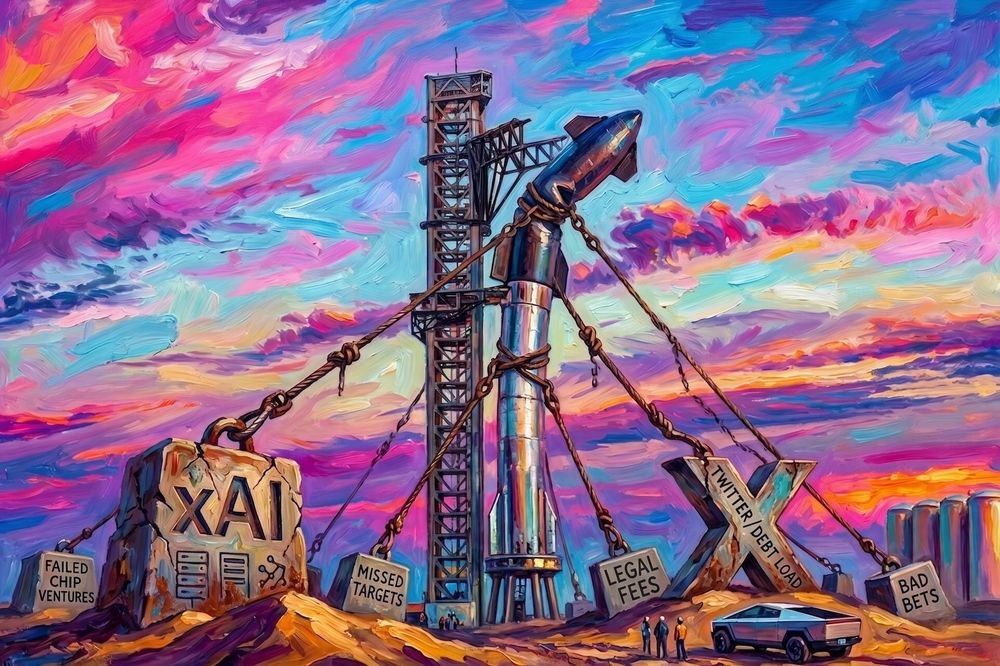
Behold the gleaming, silver phallus aimed squarely at the bruised velvet of the cosmos. It’s deeply romantic, isn't it? The glittering promise of a Martian utopia. The dream of a ubiquitous, invisible web of internet raining down like digital manna to the most remote corners of the globe. Now, swallow hard, wipe the stardust from your eyes, and look down at the form S-1 because SpaceX has officially filed to go public.
SpaceX is a cosmic dandelion seed engineered to carry humanity’s future across the vastness of space. But beneath the breathless, soaring poetry of human expansion, the filing reveals the company's true, grinding primary mission of bailing out the smoldering, cash-incinerating disasters of X (formerly Twitter) and xAI.
By surgically grafting these ventures into its corporate belly, SpaceX is politely asking the public market to foot the bill for a staggering $20 billion debt bailout, multi-billion-dollar operating losses, and a few ridiculously lucrative exits for private insiders.
From whence the greater fool
The machinery of capitalism requires blood, and in this case, the blood takes the form of a $20 billion bridge loan executed in March 2026, two months before the IPO filing.
It’s a bridge built out of public money and designed to carry the bloated carcass of X and xAI out of the private markets. According to the S-1, the proceeds were immediately used to extinguish the toxic, high-interest debt dragging down those acquisitions, including 12.5% senior secured notes and expensive floating-rate term loans.
To put this old debt out of its misery, SpaceX swallowed a brutal $1.5B in debt extinguishment losses in the first quarter of 2026. And the best part? SpaceX will use the IPO proceeds to repay this exact $20 billion bridge loan.
While the public is asked to buy the debt, insiders are already putting on their parachutes. The S-1 outlines a series of pre-IPO shenanigans heavily favoring existing royalty:
- In the first quarter of 2026, SpaceX spent $2.41 billion repurchasing stock from xAI employees.
- In that same quarter, they spent another $1.93 billion cashing out existing shareholders at fair market value.
- SpaceX is currently carrying $7.92 billion in toxic, long-term related-party debt disguised as a failed sale-leaseback arrangement with board member Antonio J. Gracias’s firm, Valor Equity Partners.
- Tesla pushed a $2 billion investment into xAI in January 2026, which miraculously transformed into 19 million split-adjusted shares of SpaceX Class A stock right before the IPO curtain goes up.
Then there is the newly formed "AI segment." Born from the February 2026 merger of xAI and X into SpaceX, the new AI division bled out $6.35 billion in 2025 operating losses in 2025, and another $2.46B in just the first three months of 2026.
- X’s advertising revenue shriveled from $2.32 billion in 2023 down to a hollow $1.84 billion in 2025.
- To keep the artificial intelligence hallucination alive, SpaceX poured $12.7 billion into AI capital expenditures in 2025.
- They stuffed another $7.7 billion into the old bird in just the first quarter of 2026.
As if the existing bags weren't heavy enough to crack the planet's crust, you might recall SpaceX just entered into an option agreement to acquire AI coding company Cursor at an implied valuation of $60 billion.
If the newly public SpaceX decides to wake up and walk away from this objectively terrible acquisition, it is still on the hook for a $1.5 billion termination fee and an $8.5 billion deferred services fee. That is a $10 billion penalty payable by SpaceX shareholders to Cursor's venture capitalists just for saying no.
The dilution stack is consequential and effective dilution to IPO investors from option pool, EchoStar shares, Cursor (if exercised), and Musk new grants could be 20–35% over a 5-year horizon, depending on milestone achievement:
- Musk's new 1.302B restricted Class B shares (not yet vested) represent potential 10% additional dilution if market cap milestones are achieved
- EchoStar shares at $42.40 fixed price represent certain dilution to IPO investors at whatever the IPO price exceeds $42.40
- Cursor acquisition at $60B equity value represents additional dilution if exercised
- The option pool of ~9.4B shares, relative to ~12.5B pre-IPO shares, is 42.86% dilution on a fully diluted basis
Valuing SpaceX
The IPO is targeting a $1.75 trillion valuation and a raise of up to $75 billion. At $1.75T with blended 2026 estimated revenue of $35–40B (including Anthropic ramp, Starlink growth, Space segment), the implied forward revenue multiple falls to ~44–50x.
Adjusted EBITDA for 2025 was $6.6 billion with Anthropic adding ~$7.5B in incremental high-margin revenue in H2 2026, 2026E Adj. EBITDA could approach $15–18B (rough estimate obviously). At $15–18B Adj. EBITDA, the $1.75T implied multiple is ~100–120x.
A 10x return requires $17.5 trillion. That's larger than any company in history by a factor of nearly 6x. The more credible frame is whether a 2-3x return over 7–10 years is even achievable in the bull case.
For a 3x return from $1.75T to $5.25T by 2033:
- Starlink reaches 50M subscribers at $75 ARPU = ~$45B revenue
- Anthropic-class contracts expand to 3–4 total, generating $50–60B in AI infrastructure revenue
- Grok enterprise becomes a $10–15B revenue business
- Space segment with Starship commercial: $8–10B revenue
- Total revenue: ~$110–130B; at 30–35x EBITDA (blended platform/infra) = $3.5–4.5T market cap
The 3x scenario requires all major initiatives to execute on schedule with no major technical failures. Do we think that is likely?
Bull / Base / Bear Scenarios
| Scenario | Key Assumptions | 2030 Revenue Est. | 2030 Adj. EBITDA | Implied Market Cap (Multiple) | Implied Return from $1.75T Entry | Probability |
|---|---|---|---|---|---|---|
| Bull | Starship commercial by H2 2026; Starlink 40M subs at $85 ARPU; Grok achieves top-3 enterprise AI; 3+ Anthropic-class compute contracts; COLOSSUS II litigation resolved quickly; no major Musk distraction; Cursor acquired and integrated | ~$75B | ~42% margin (~$31B) | ~$4.0T at 130x Adj. EBITDA | ~2.3x | 20% |
| Base | Starship slips to 2027; Starlink 25M subs at $75 ARPU; Anthropic contract holds through 2028; 1 additional compute contract; Grok breaks even; COLOSSUS II litigation settles; EchoStar closes on schedule | ~$48B | ~35% margin (~$17B) | ~$2.0T at 120x Adj. EBITDA | ~1.1x | 50% |
| Bear | Starship delayed >2 years; Anthropic terminates compute contract (90-day notice exercised 2027); Kuiper achieves 10M+ subscribers by 2029; COLOSSUS II gas turbines shut down by court order disrupting Grok 5 training; X platform user erosion; government contract concentration exposed to political shift post-2028; Musk distraction repeats | ~$28B | ~20% margin (~$6B) | ~$500B at 80x Adj. EBITDA | ~0.29x (approx. -71%) | 30% |
Probability-weighted expected return from $1.75T entry: (0.20 × 2.3x) + (0.50 × 1.1x) + (0.30 × 0.29x) = 0.46 + 0.55 + 0.09 = ~1.10x — approximately flat in expected value from IPO at $1.75 trillion.
Note: The Anthropic compute contract's 90-day termination risk means it cannot be fully underwritten as durable revenue.
Where valuation is richest relative to what's de-risked
I think the Connectivity segment is the most de-risked business: $11.4B revenue, $4.4B operating income, 10.3M subscribers, zero enterprise churn, $7.2B Segment Adjusted EBITDA. Standalone, at 25–30x EBITDA, this is worth maybe ~$175–215B.
The Anthropic compute contract at full rate adds ~$10–12B in incremental EBITDA at high margins (compute rental is predominantly hardware depreciation, power, and minimal labor). Capitalized at 25–30x, this adds $250–360B but only if durable. At 90-day termination risk and a counterparty building its own alternative, a more conservative 10–15x is appropriate, implying ~$100–180B of incremental value.
The total of demonstrably de-risked businesses (Connectivity + Anthropic contract at risk-adjusted value + Space launch) is ~$300–450B. The remaining ~$1.3–1.45T of the $1.75T valuation is attributable to:
- Starship commercial optionality
- AI model (Grok) enterprise scale
- Starlink Mobile Gen2 (EchoStar spectrum)
- Additional compute contracts
- Orbital AI compute (speculative)
IPO investors are paying 3–4x the demonstrably de-risked asset value for the portfolio of options. Each of those options has meaningful probability of failure or delay.
I must give credit where it's due. SpaceX’s core space and connectivity businesses are genuine, profitable miracles. The Connectivity segment alone generated a luscious $4.42 billion in operating income in 2025. The stars are beautiful. The rockets are real.
Unfortunately, the ticket you are buying in SPCX isn't for Mars. It's the itemized receipt for Elon's mistakes back here on earth. At $1.75 trillion, it is the most exquisitely engineered, stainless-steel bag in human history.
You'll buy it anyway.
A note on method and sourcing. All financial figures, dates, share counts, and corporate facts in this article are drawn from public filings with the U.S. Securities and Exchange Commission except where another source is named. Valuations, scenario probabilities, estimates, and characterizations of the transaction are the author's analysis and opinion, not statements of fact. Reasonable people may weigh the same filings differently. Nothing here is a prediction of how any security will trade. This article is journalism and commentary. It is not investment, legal, tax, or financial advice, and it is not a recommendation to buy, sell, hold, or vote any security. The author holds no position in any security mentioned. Readers should consult the primary filings and their own advisors before making any decision. Research and drafting for this article were assisted by AI tools which can make mistakes.