


Claude is priced like the best AI model in the world, because for an awful lot of work out there, it is. Anthropic’s top model, Claude Fable 5.1, lists at $10 per million tokens in and $50 per million out. That output price is about 8 times what Alibaba’s largest open model, Qwen3.8, charges, and about 13 times DeepSeek V4 Pro, both released in August. In the first half of this year Anthropic spent about $2.4B serving customers and billed them $16.3B, a margin of about 85% before the cost of training, according to a footnote in its IPO filing. That markup is what public investors are being asked to buy, at a valuation somewhere north of $1.5T.
A premium like that lasts as long as the lead is large. Open models anyone can download are improving fast, and for a growing share of work good enough is all a customer needs. These models now handle about 34% of enterprise AI tokens, up from 23% a year ago, according to a recent ETR survey reported by Techstrong. No one pays $50 per million for work a $4 model does well enough.
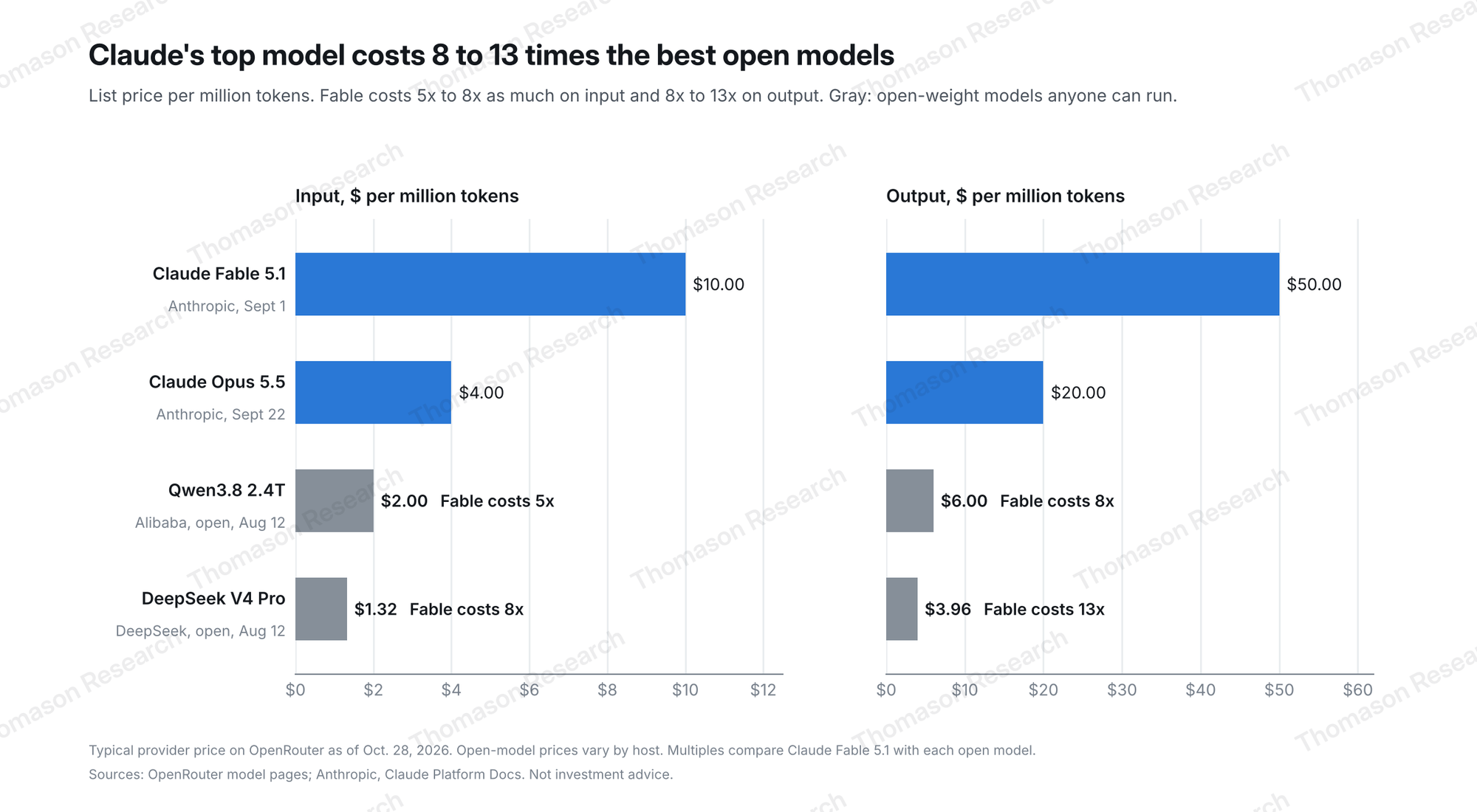
Anthropic’s first way out is to keep pulling ahead. The past year doesn’t show it doing so. Claude tops the Arena leaderboard, but Google and xAI sit within 9 points of it, according to Stanford’s 2026 AI Index. The best open models trail the closed frontier by about four months, Epoch AI estimates, a lag that has held roughly steady for a year. Every model Anthropic ships has about four months before an open model can do the same work at as little as a tenth of the price.
The other way out is to sell something a cloud marketplace can’t shelve next to DeepSeek. Anthropic has launched seven industry products, from finance to law to life sciences. Its finance agents draft credit memos and run know-your-customer checks inside Excel and PowerPoint, and JPMorganChase, Goldman Sachs and Citi use them in production, Fortune reported. A bank that has wired Claude into its compliance work has more reasons to stay than a developer comparing token prices. So far, though, tokens are the business. Usage-metered revenue was 80% of the first half’s total, and Anthropic expects it to remain “the substantial majority” for the foreseeable future.
But today Anthropic’s margins are in a pincer. If it holds its price, the good-enough work withers away and Anthropic’s compute sits idle. By our count of the filing, it owes about $431B for compute whether it uses the capacity or not. If it cuts its price to keep the work, every token earns less. It has already started cutting. In September it cut the cost of reusing stored context on Fable 5.1 by 75%, which it estimated would trim bills by about 25% for typical work and up to 45% for agentic work. Three weeks later it released Opus 5.5 at 40% of Fable’s price.
The compute landlords couldn’t care less which model is running. Amazon rents Anthropic much of its computing power and handles a big slice of its sales, and it sells Qwen and DeepSeek on the same Bedrock marketplace as Claude. Google sells DeepSeek on Vertex, and Microsoft sells DeepSeek and Qwen on Foundry. Neoclouds get paid for every hour a chip runs, whoever’s model is on it. When we modeled a gigawatt data center, open models barely dented the landlord’s value. In our Anthropic simulation, a price per token that falls 15% further than costs by 2030 erases about a fifth of the company’s value. At 30%, it erases about half.
Anthropic needs its premium, or else.
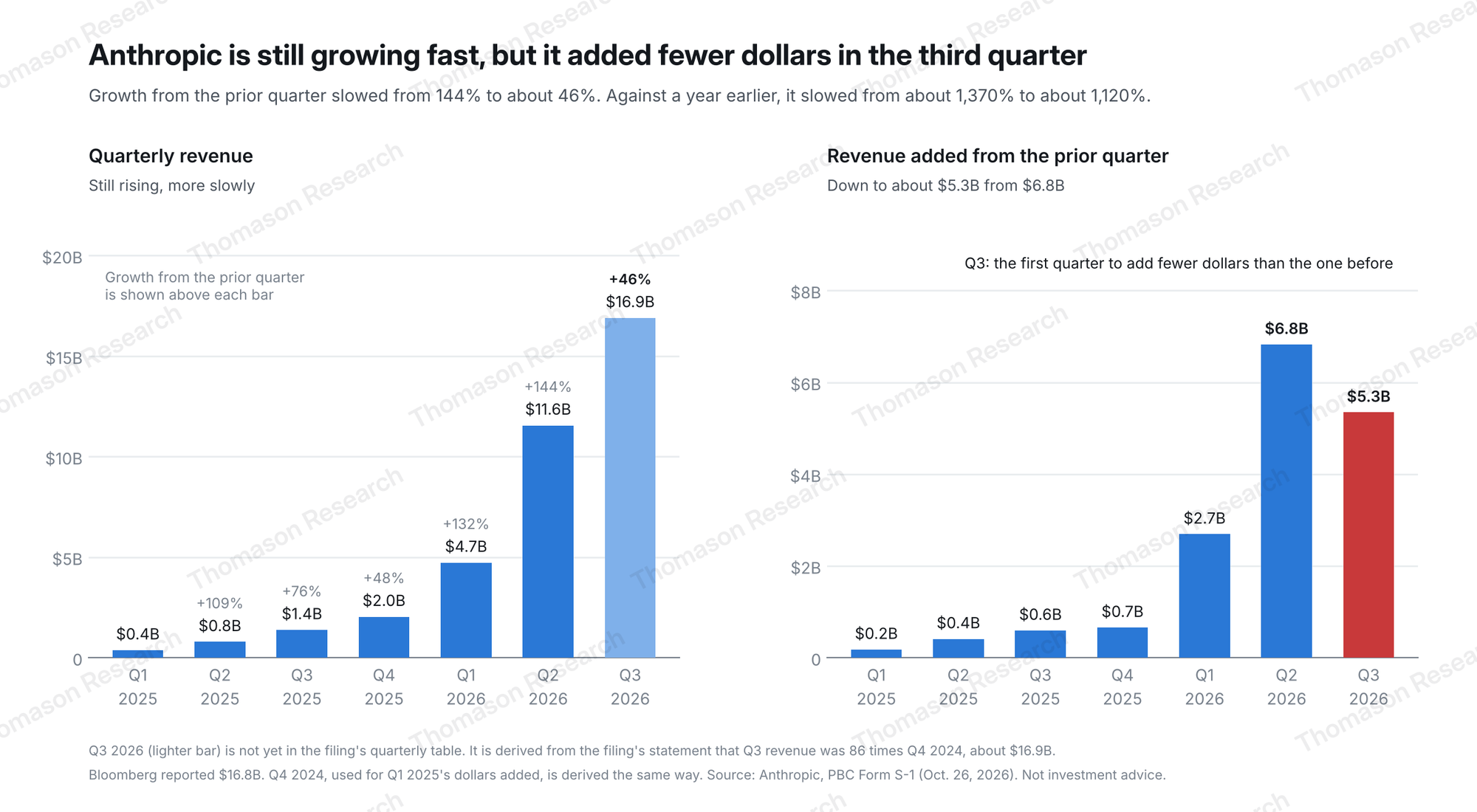
So far the premium holds. Anthropic sold $41M of AI in 2023 and about $33B in the first nine months of this year, the kind of growth curve that makes venture capitalists weep into their oat-milk cortados. The company calls it "the fastest enterprise adoption of any technology in history." Third-quarter revenue reached about $16.9B, according to figures deep in the filing, backing up a figure Bloomberg reported earlier.
But for the first time, Anthropic added fewer dollars than it did the quarter before, about $5.3B against $6.8B. Quarterly growth fell from 144% in the spring to about 45%. Annual growth slowed too, from about 1,370% to about 1,120%. That is still nosebleed growth, and investors are already marking it down. Reuters reported that talk of a $2T valuation had cooled to about $1.5T.
Anthropic is listing anyway, because it must. It has about $132B of cash and roughly $850B of computing power on order over the coming decade, and much of the money for the rest was built to arrive as stock, which requires a stock. Amazon and Google have agreed to buy up to $35B of shares at a 30-day average trading price. Amazon's $6.2B of early loans turn into stock on listing day. Broadcom, owed about $161B in equipment lease payments, will lend up to $42B toward the rent and can convert that debt into shares at a 10% discount.
Its people are waiting too. Roughly a billion employee RSUs can't vest until Anthropic lists or is sold, and they evaporate if neither happens within seven years of the grant. Listing now also puts Anthropic in front of public investors before OpenAI, which is leaning toward a 2027 IPO and raising up to $30B privately in the meantime.
I simulated the Anthropic offering 20,000 times. The business survives nearly every run. But the stock ends its first year above the offer price in only about 1 time in 3.
The call
At about $1.6T, Anthropic is priced for about $376B of revenue in 2030. Our simulation gets a median of $259B. We think the stock trades up on day one and then spends most of its first year below the offer price as 95% of the share count unlocks. At $1.6T, we think most of the good outcomes are priced in.
The number to watch is revenue per dollar of compute. It rose from about 50 cents in the first half of 2025 to $2.08 in the second quarter of this year. If Anthropic’s prices start falling faster than its cost of serving each token, that figure turns down, and more usage won’t bring it back.
Anthropic’s first full-year results arrive about three and a half months after the listing, and the first-quarter 2027 report lands around the day roughly 75% of the shares become free to sell.
Revenue quality
The demand behind the revenue is broad and deepening.
- More than 11,900 customers paying $100K or more a year at September 2026, up from about 950 a year earlier.
- More than 1,900 paying $1M+, and about 250 paying $10M+.
- Net revenue retention of about 900%. Existing customers spend nine times what they spent a year ago.
- Q2 2026 was the first quarter of GAAP operating profit, $974M on $11.6B of revenue.
- Cash and short-term investments of $131.7B at June 30, before the IPO.
About 48% of Anthropic’s first-half revenue came through cloud marketplaces run by Amazon, Google and Microsoft. Anthropic books the full sale as revenue and the fees as an expense. It paid channel partners, the marketplaces among them, at least $2.7B in the first half. Net of those fees, first-half revenue falls from $16.3B to about $13.6B. At $1.6T, that means paying about 28x annualized sales instead of 24x. Google and Amazon also rent Anthropic much of its computing power and own large stakes in the company.
Anthropic says 5% to 7% of revenue in the first nine months, roughly $1.7B to $2.3B, came from customers that broke its usage rules. It stepped up enforcement in August and September and says cutting those customers off may further reduce revenue and growth.
Customer concentration is falling. No customer accounts for more than 10% of revenue, and the share from outside the top five rose from about 64% in the first quarter to 79% in the third.
Cheaper tiers are part of the bet. Opus 5.5, released in September, lists at $4 per million input tokens and $20 per million output, 40% of the price of Anthropic’s top model, Fable 5.1. If customers move work down to it, revenue per token falls even when list prices don’t.
The open model threat
If open models and its own price cuts push Anthropic's price per token 15% below what its cost gains can match by 2030, the business loses about a fifth of its value. At 30%, value roughly halves and the return on capital falls to about the cost of capital. The same pressure moves a data center landlord's value by a few percent.
- The landlord sells GPU-hours. An open-weight model such as Qwen or DeepSeek runs on the same chips as Claude. When cheaper models make AI cheaper to use, people use more of it. More usage means more GPU-hours rented, so in the GPU-hour model the demand channel added about 4% to a gigawatt's value. The landlord's real exposure was to the labs' credit.
- Anthropic sells priced tokens. Its margin depends on the price of each token relative to the compute cost of producing it. Open models set a ceiling on that price close to the cost of running them. The Jevons effect brings more volume, but every extra token needs its own compute. So compute as a share of revenue rises with any price cut that costs do not match, however much usage grows.
- Anthropic carries the fixed bill. The landlord is protected by take-or-pay contracts. If token prices fall, the rent on the fixed part of the bill stays the same.
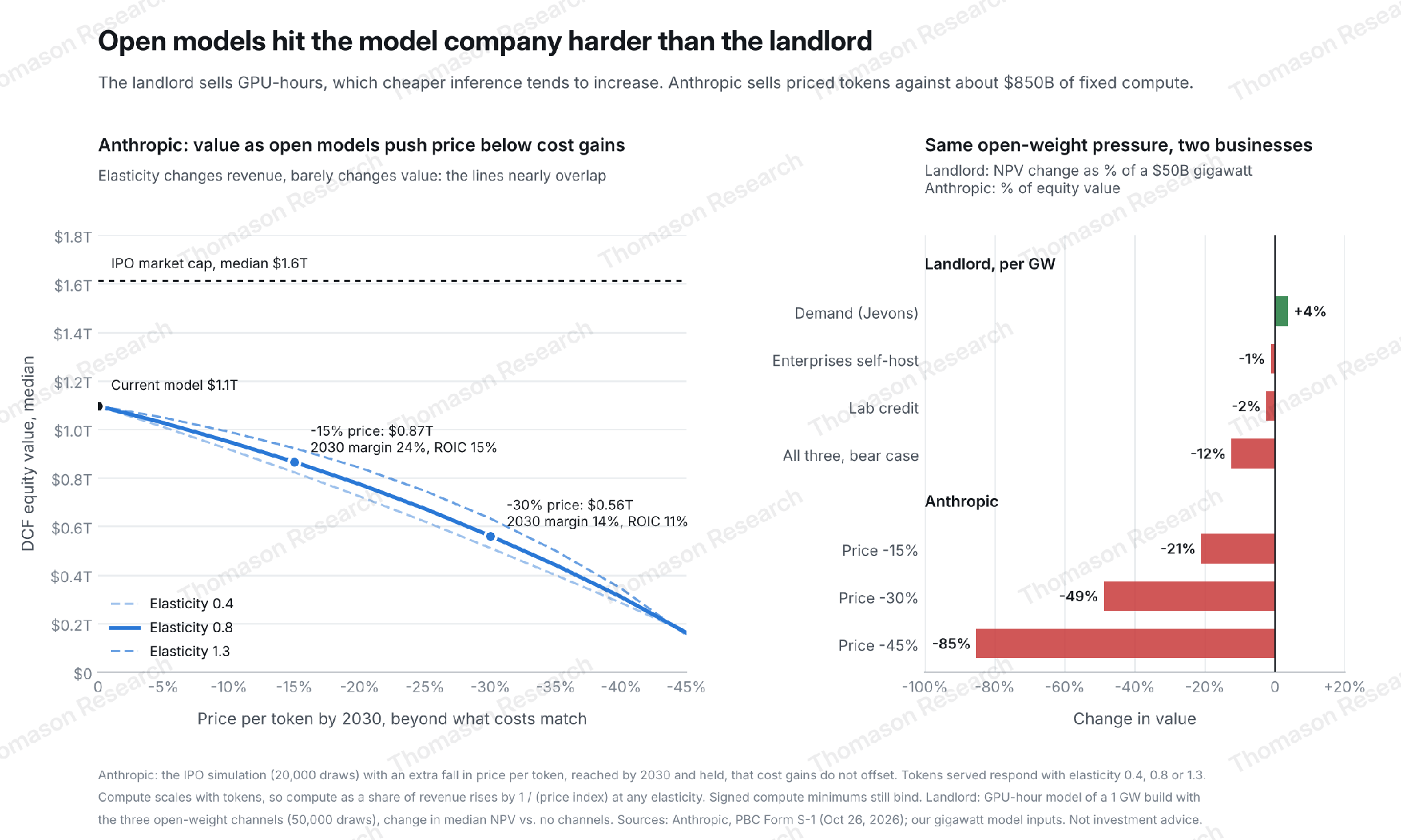
Whether usage responds weakly or strongly to lower prices barely moves the value. Usage growth changes how large Anthropic's revenue gets, while the margin, and with it the value, is set by price against cost.
Models less than six months old earned more than 80% of Q3 revenue, and open models have trailed the frontier by months. Enterprise customers are expanding spend rather than switching.
The compute bill
Anthropic has signed roughly $850B of minimum compute and infrastructure payments, about 13 times its annualized revenue. That figure adds $265.6B of fixed commitments at June 30, $321.4B of leases signed but not yet started, about $245B signed after June, and $21B of short-term obligations. Contingent TPU orders of $125B to $150B for 2028 to 2031 and more than $20B with AMD sit on top. The filing says the company "significantly underestimated our compute requirements" in the past, and this is the fix.
Not all of that bill is equally fixed. The commitments to Google, Amazon, Microsoft and Broadcom, about $431B, must be paid whether or not Anthropic uses the capacity, or are leases it can't cancel unless the other side breaches. The rest is softer. Either side can cancel the SpaceXAI contracts on 90 days' notice once their first months are up. Nscale and Lambda are paid only as capacity is delivered, and either side can end Lambda's largest contract, about $34.9B, if Lambda can't secure the building. If growth slows, Anthropic can shed the neocloud layer first, and those suppliers would feel it before the hyperscalers do.
Customers have committed to far less. Anthropic's remaining performance obligations, revenue customers are contractually bound to pay, were $10.8B at June 30. The filing warns that many top customers "are able to reduce or in some cases cease spending at any time and for any reason."
In our GPU-hour model, the lab tenant's credit was the weak link for landlords. On these numbers Anthropic is the best tenant in the market: $131.7B of cash, about $59B of IPO proceeds, a $15B credit facility and $77B of undrawn notes. Its commitments are the revenue of Nscale, Lambda, SpaceXAI and Broadcom.
The signed minimums keep rising through 2029 whether revenue does or not. In our simulation the minimums exceed what the business needs in 51% of draws in 2028, which is how a slowdown turns into a margin problem.
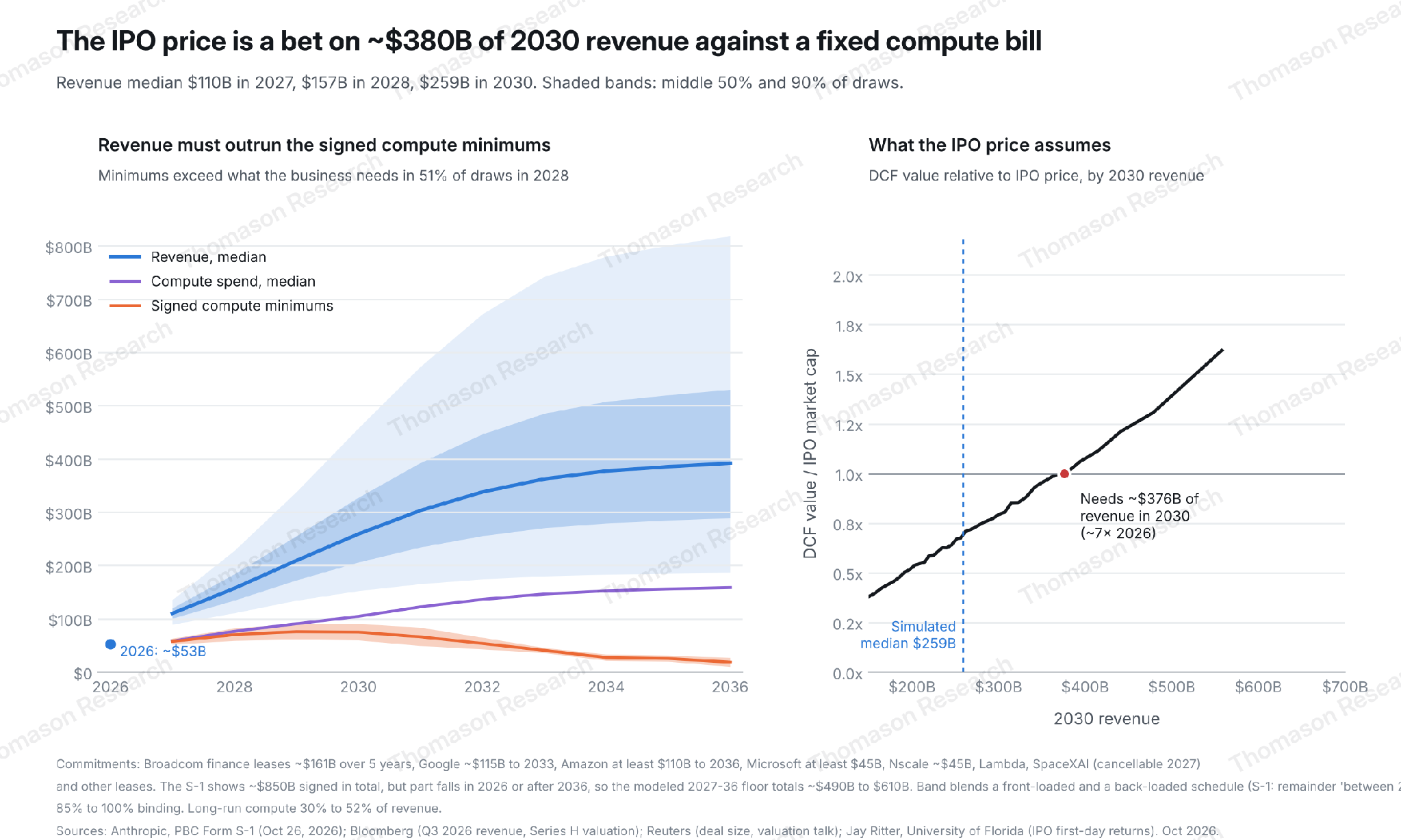
Forbes notes that the valuation rests on a 2028 forecast of $190B to $200B. Our median for 2028 is $157B, and 21% of draws reach $190B.
Profits, adjustments and dilution
Anthropic lost $80.7B in the first half of 2026 under GAAP and made $2.7B on its own adjusted measure. Almost all of the difference is accounting for financing.
- Gross margin. The company moved gross profit off the face of its income statement in 2025. A footnote still reports the cost of serving customers, $2.4B in the first half, which implies a gross margin of about 85%. Training compute sits in research and development, so that 85% describes a business that only exists because of the training spend. The filing also warns that buying more short-term compute, which costs more per unit, will "compress our operating margin" in the near term.
- Stock pay is large and front-loaded. $2.2B was expensed in the half, and $26.6B of granted but unvested stock pay is still to come. The new equity plan reserves 2.95B shares, about 17% of the company, plus 160M for an employee stock purchase plan, both with annual top-ups.
- A change of auditor. Grant Thornton was replaced by EY on October 30, 2025, with no reason given.
Return on invested capital
Counting its rented compute as capital, Anthropic earned about 9% after tax at its Q2 2026 run-rate, just under a ~10.5% cost of capital. The simulation puts that return at 13% in 2028 and 19% in 2030, above the cost of capital in 97% of draws by 2030.
This is the test we used on CoreWeave, after-tax operating profit divided by the capital tied up to earn it.
Anthropic has only about $7.9B of operating capital (receivables, equipment, leases and other assets less payables and deferred revenue), so Q2's $974M of operating profit looks like a 39% return. The compute that produces the revenue is rented, so it never appears as an asset. The fix is the standard lease adjustment: treat the rent as if Anthropic owned the hardware.
- Capital. Q2's compute bill was $5.6B, or $22.2B a year. Capitalized as 4 to 7 years of rent at the 7% to 10% a landlord earns, that is about $94B. Add the $7.9B and invested capital is about $102B.
- Profit. Operating profit plus the interest cost embedded in the rent, taxed at 21%.
- Breakeven margin. On those inputs, Anthropic needs a GAAP operating margin of about 12% to earn its cost of capital today. It earned 8.4% in Q2, or 19% on its adjusted measure.
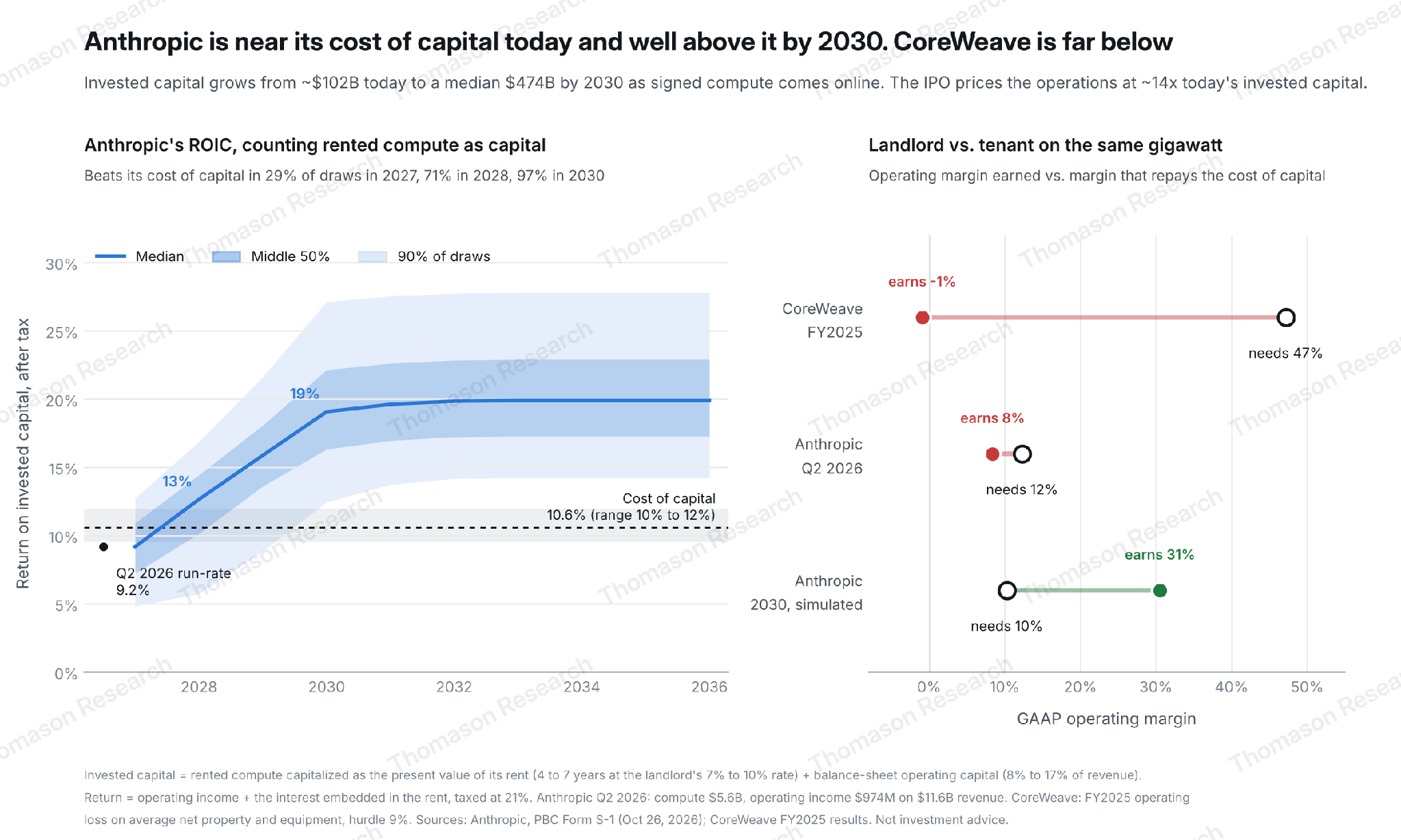
CoreWeave needed a 47% operating margin on FY2025 assets and earned -1% in our analysis. Anthropic needs about 12% now and about 10% by 2030, and the simulated 2030 median is 31%. The landlord owns the depreciating asset and the debt behind it. The tenant rents a gigawatt-year for about $12B and sells about $25B of model output from it, roughly 2.5 times what OpenAI earned per gigawatt. The return on a gigawatt is earned at the model layer.
The dip in 2027 is the cost of the commitments. Signed compute arrives ahead of the revenue it is meant to serve, so invested capital grows to about $260B in 2027 and ROIC beats the cost of capital in only 29% of draws that year. By 2030 invested capital is a median $474B.
The IPO values the operations at about 14 times today's invested capital. A mature business earning 20% on capital, with a 10.5% cost of capital and 4% long-run growth, is worth about 2.5 times its capital. Closing that difference takes a capital base roughly six times today's, all earning about 20%. In the simulation that is the upper quarter of 2030 outcomes. ROIC holds near 18% to 20% in every scenario, from bull to price war, as long as Anthropic's price per token keeps pace with its cost. A 30% gap pulls returns down to about the cost of capital.
The trade
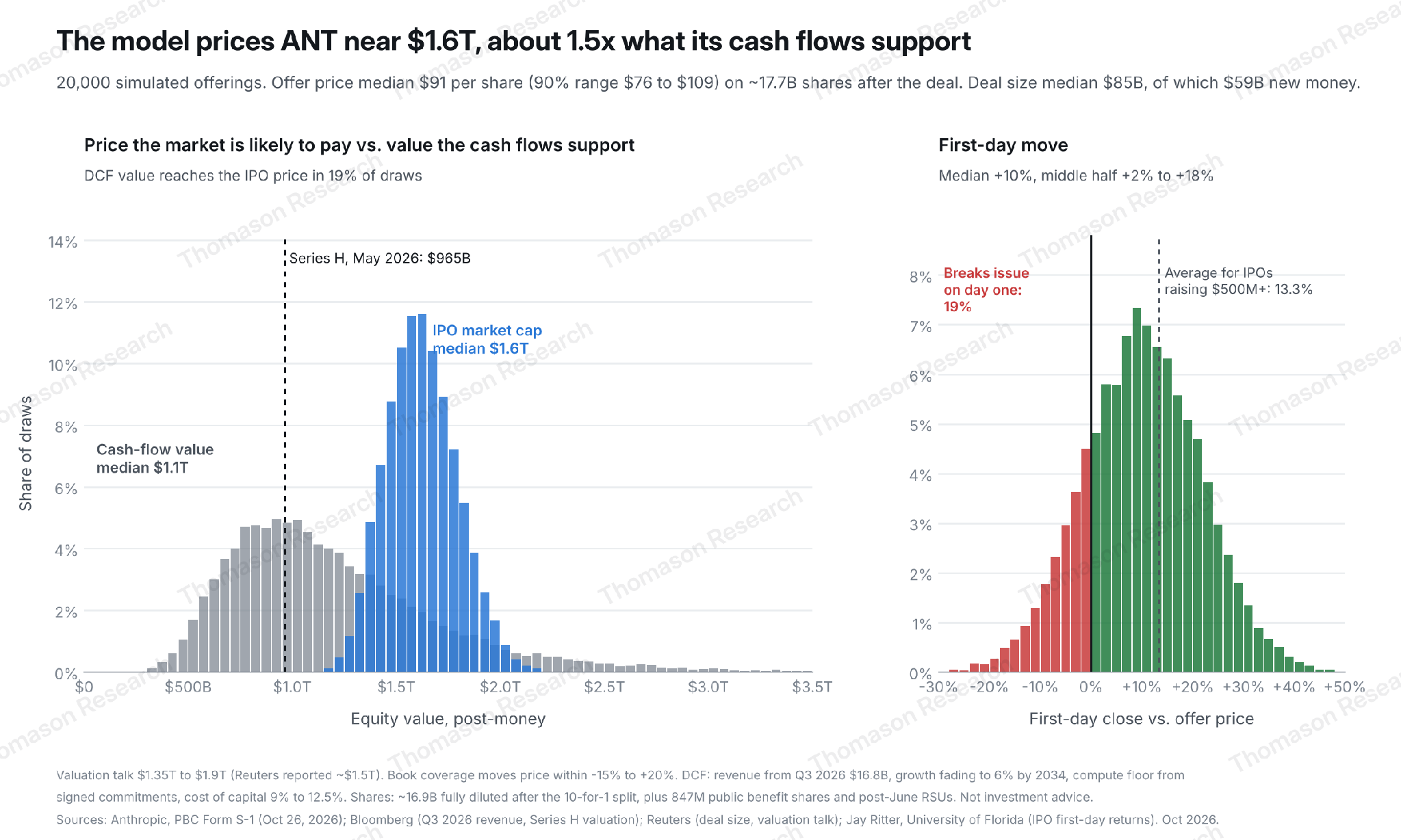
The median first-day close is 10% above the offer. That is close to Jay Ritter's 13.3% average for IPOs raising more than $500M, and below the 19% SpaceX gained on its first day in June. The stock closes below the offer on day one in 19% of draws. Morgan Stanley is the stabilization agent and will defend the price in early trading, which trims that tail.
SpaceX priced at $135, closed its first day near $161, and traded at $147.49 on October 23, Reuters reported. Buyers at the first-day close are still down about 8%. Anthropic arrives with a larger deal, faster revenue growth and a heavier unlock calendar.
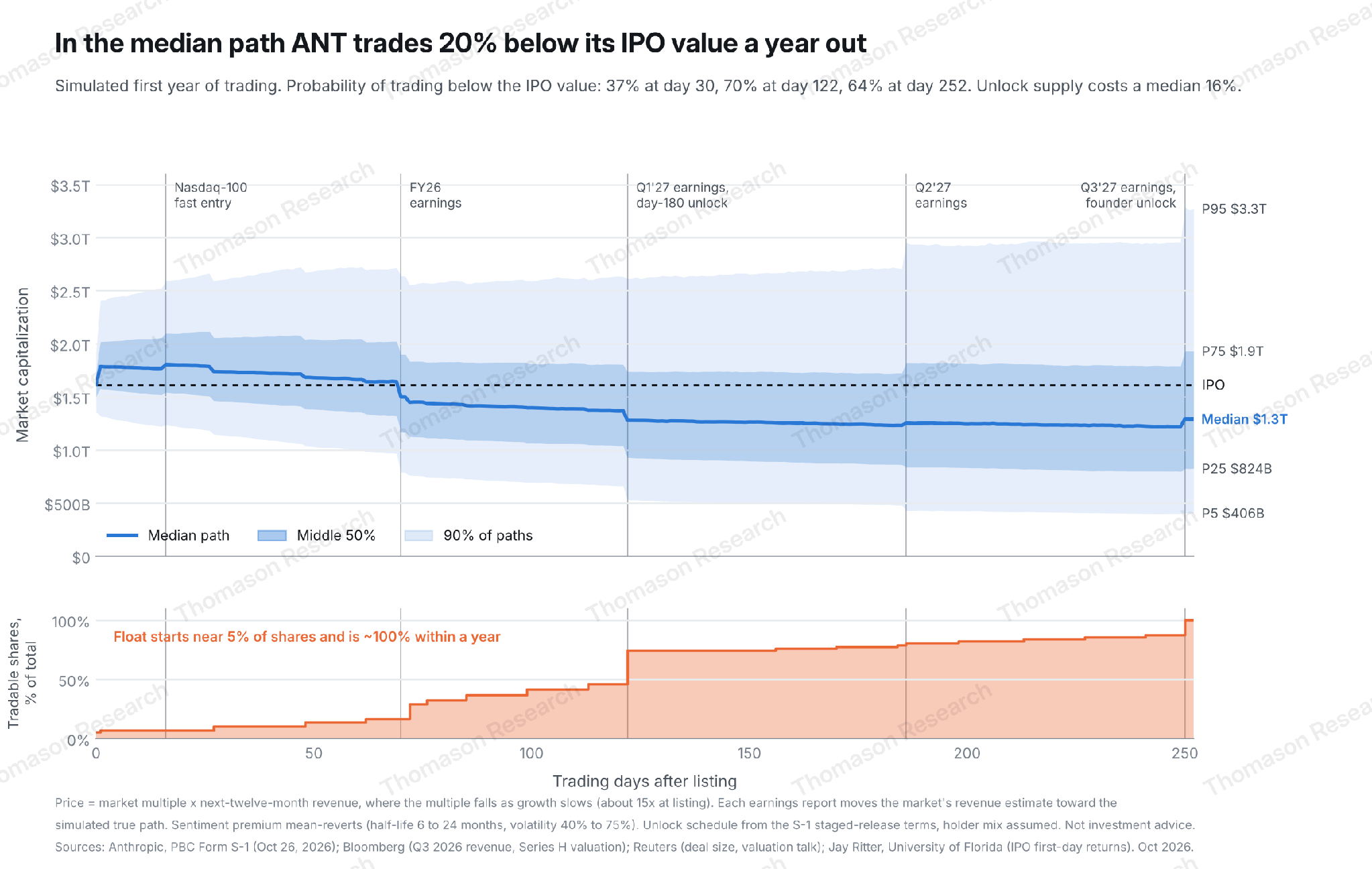
The deal sells about 5% of the company. The S-1's staged lock-up releases then free shares in tranches: employees and directors from day one (up to 10% of their shares), the 180-day investors in steps after the FY26 report, and founders and holders above 0.5% through Q3 2027. In the model about 75% of shares can trade by day 122 and nearly all by day 252. Across the year, the added supply takes a median 16% off the value.
The key dates, in order:
- Day 16, Nasdaq-100 fast entry. Index funds can buy only after the 15th trading day, and the index counts up to three times the shares that actually trade, so funds must buy a large slice of a small float. The model adds about 2%, which may understate it.
- Day ~19, the first investor release. The 27th calendar day after the prospectus frees the first tranche of the 180-day group and the first shares from the 365-day group, about a week after the index buying. The S-1 leaves the sizes blank.
- Day ~70, FY26 earnings. The first public print, and the trigger for a 12.5% release of the 180-day group plus 35% of employee shares.
- Day ~122, Q1 2027 earnings and the day-180 unlock. The largest single release, about 28% of all shares, including up to 29% of the founders' stock. This is the date with the most downside risk.
- Day ~250, Q3 2027 earnings. The last founder and large-holder shares unlock.
The probability of trading below the offer is 37% at day 30, 70% at day 122 and 64% at day 252. The partial recovery after day 122 comes from paths where revenue keeps beating.
Scenarios
In the bull case, about 1 run in 5, the typical outcome is a gain of about 29% after a year. In the base case it's roughly flat, and in the bear and price-war cases buyers lose a third to a half.
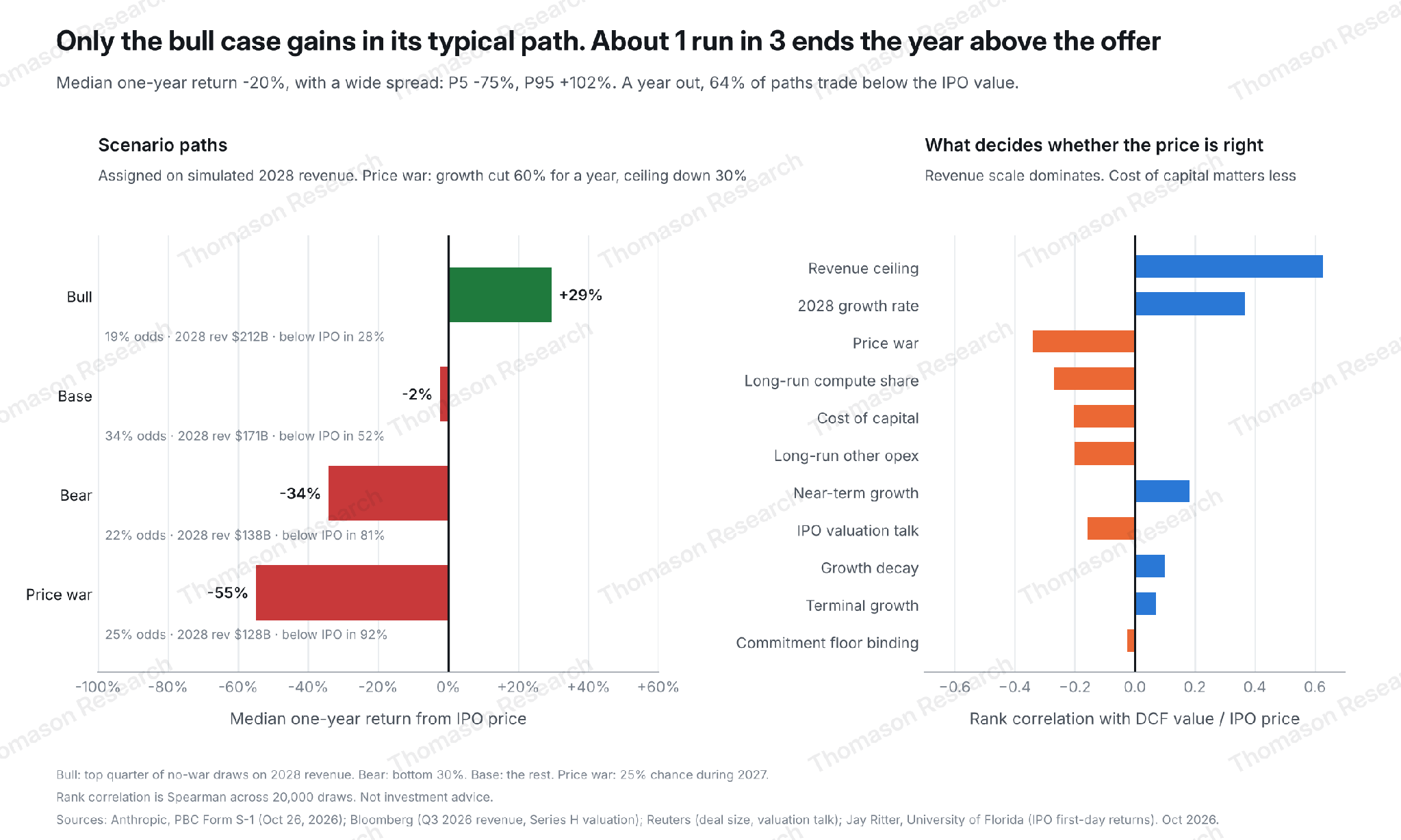
The bull case needs Anthropic to grow revenue about 2.5 times in 2027 and keep compounding above 45% a year to 2030. The price-war case starts from almost the same 2027 revenue as the bear case but trades worse, because the market sees the cut in its multiple at once.
The ceiling on how big the business can get, and its 2028 growth rate, matter far more than the cost of capital or the terminal growth rate.
What would change the view
The case for paying up is that Anthropic keeps its price premium. If each new model holds its price per token while the cost of serving it falls, the margin widens as usage grows, revenue compounds faster than our model allows, and the signed compute becomes an advantage rivals cannot buy.
- Revenue per unit of compute. Each quarterly report shows revenue and compute spend. If revenue keeps outgrowing compute while prices fall, the premium is holding. If compute catches up, the Jevons trap is closing.
- Q4 2026 revenue above $21B (25% growth) would put the base case in doubt and the bull case in play. Below $19B confirms the bear case.
- Q3 margins in the amended filing. The S-1 warns that pricier short-term compute will squeeze margins near term. A gross margin well below the first half's 85% would confirm it.
- Marketplace share of revenue. A falling share means more direct sales and cleaner, higher-margin revenue.
- Adjusted operating margin above 25% in the FY26 report, with compute below 45% of revenue.
- The D.C. Circuit's en banc decision. A reversal removes the largest policy overhang.
- Broadcom note draws. Each draw is discounted stock. Silence through mid-2027 would be a good sign.
- SpaceXAI. Whether Anthropic exercises its right to cancel after Q1 2027 shows how management reads its own demand.
- The day-122 unlock. If the stock holds the offer price through the largest release, the supply argument is spent and there is little reason to keep waiting.
The fine print
The convertibles
The expensive conversion has already happened. Amazon lent $6.2B on notes that convert at $2.09 and $5.05 a share. At a $91 offer price those shares are worth about $167B, and that repricing drives most of the $72.4B first-half charge. Those 1.84B shares are already in the fully diluted count, so IPO buyers are not diluted by them a second time. The notes still outstanding cost little in expected value. One of them, Broadcom's, is built to dilute hardest when the stock is weakest. Its notes convert at a discount to the market price with no floor. If a $50B balance converted at 85% of a $40 stock, Broadcom would receive about 1.5B new shares, about 8% of the company.
- Public Benefit Issuance ratchet. The board may issue another 2% of the company to the benefit fund each time the price rises 50% from the last milestone, starting at the IPO price. In the simulation that triggers in 39% of first-year paths. It trims the upside paths only.
- Options. 1.80B options at a $2.89 average strike bring in $5.2B when exercised. The model now adds that cash.
- Donation matching. 28M Class N shares issued in October 2026 for the employee donation match.
The tax on the RSUs that settle at the IPO is paid in cash from the proceeds, and the shares covering that tax are withheld. That is value neutral at the offer price but leaves less new money on the balance sheet.
Control, courts and Washington
Public buyers get economic exposure with no say over the company.
- Five share classes. Class A (one vote) is what the IPO sells. Class F, held by an LLC of the seven co-founders, carries 50.1% of the vote and sunsets only if fewer than three founders remain for 90 days, followed by a 450-day transition. Class T lets the Long-Term Benefit Trust elect a majority of the board. Class N is non-voting stock for Amazon and Google, capped at 12% and 14.99%. Anthropic will be a controlled company and can skip some Nasdaq governance rules.
- A public benefit corporation. The board must weigh the mission alongside shareholder returns.
- The Pentagon dispute. The Department of War designated Anthropic a supply-chain risk. A D.C. Circuit panel upheld that 2-1 on September 25, 2026, and the company has asked for a rehearing by the full court. A loss limits federal work and could spill into contractors' buying decisions.
- Export controls. Commerce restricted access to Fable 5 and Mythos 5 in June 2026 and lifted the controls on June 30. The episode showed that a single agency decision can switch off the newest products for weeks.
- Copyright. The $1.5B Bartz settlement is booked. Suits from music publishers, Reddit and Canadian plaintiffs are pending.
- Contract triggers. Several financing and supply agreements carry cross-default and key-person clauses, so trouble in one contract can accelerate others.
How the simulation works
The model runs 20,000 versions of the offering and its first year of trading. Each draw links three layers, so a weak business, a hot book and a heavy unlock can all land in the same path.
- The business. Revenue starts from Q3 2026's $16.8B. Near-term growth of 8% to 35% a quarter fades toward an underlying rate of 15% to 90% a year in 2028, then glides to 6% by 2034, with a ceiling on total revenue centered on $800B a year. Compute spend falls from 48% of revenue toward 30% to 52%, but never below the signed minimums. Other costs fall from 44% toward 20% to 35%. A price war hits in 2027 in one draw in four. Free cash flow is discounted at 9% to 12.5% to get what the business is worth.
- The offering. Valuation talk sits between $1.35T and $1.9T, centered on $1.6T. Order-book demand moves the final price between 15% below and 20% above the talk. The deal raises $70B to $100B, 55% to 85% of it new money, on about 17.1B fully diluted shares after the 10-for-1 split. Amazon's notes are already in that count. Broadcom's discounted notes, option exercise cash and the Public Benefit ratchet are modeled explicitly.
- The first year. The market prices the stock at a multiple of next year's revenue, and that multiple shrinks as growth slows. At listing it is about 15 times. Each earnings report reveals more of the true revenue path. Unlocked shares add supply, Nasdaq-100 fast entry adds demand on day 16, and a sentiment premium drifts back toward zero over 6 to 24 months.
Method and limits
- Inputs. All company figures come from the S-1 filed October 26, 2026, except Q3 2026 revenue (Bloomberg) and valuation talk (Reuters). The price range and share counts are blank in the filing, so the offer price is modeled. The split of locked-up shares by holder type is assumed.
- Limits. The model has no view on macro conditions, rival IPOs (OpenAI has filed confidentially) or index flows beyond fast entry. Ranges are judgment calls, and the scenario odds are the model's, not market prices.
- Mistakes. I am often wrong and make mistakes.
- Not advice. This is an analytical exercise. It is not a recommendation to buy or sell any security.
Sources
Filing
- Anthropic, PBC, Form S-1 registration statement, filed October 26, 2026: income statement, cash flows, key metrics, contractual obligations, capital structure, lock-up terms and risk factors.
News and analysis
- Bloomberg, Anthropic Revenue Hits $16.8 Billion in Quarter Before IPO, October 2026.
- Bloomberg, Anthropic Raises at $965 Billion Valuation, Eclipsing OpenAI, May 2026.
- Reuters, Factbox: Anthropic moves closer to blockbuster listing with US IPO filing, October 26, 2026.
- Al Jazeera, AP and Reuters, Anthropic's IPO filing shows explosive growth, risks and staggering costs, October 26, 2026.
- Forbes, 3 Things To Know As A Potential Anthropic IPO Nears, October 23, 2026.
- Axios, SpaceX shoots 19% higher in first day of trading, June 12, 2026.
- Jay Ritter, University of Florida, IPO Statistics.
- Ramp, AI Index, corporate card data on AI spend.
- SemiAnalysis, compute cost per gigawatt, as used in our earlier report The Gigawatt Question.
- Nasdaq, Nasdaq-100 Index Methodology, effective May 1, 2026: fast entry and low-float rules.
Model files: ant_ipo_mc.py (simulation) and ipo_charts.py (charts), available on request.